To succeed, you need to be demanding-- there is no doubt of that in my mind. A few days ago I was watching some old reruns of Steve Jobs presenting at the Mac World 1998. This was when he made his return to Apple, lopped out useless products and decided to focus on 4 produced and decided to make them the best in their class. The result of his efforts and vision resulted in the birth of the iMac, the G3 Mac and the powerbook after killing the other branded lines of Apple computers.
It was fascinating to see Jobs in his presentation outlining how his products were the best in their class and how they would not settle for any second best position-- to come this far in the product development cycle to make such compelling products it was obvious at they had a demanding goals and pushed to have them accomplished. After that, they just kept on going, leading to some of the best designed computers and portable electronics devices today, leading to windfalls in profits. They were well respected in their early years because they were humble and demanding... times may have chanced since their climb to the top, however I'll leave that as a different issue to tackle at a later date, because you need to get there first in order to have those kinds of problems.
The first thing about becoming more demanding is to not get too used to anything, because when you get used to something things start to get easy and as a result you get lazy. When that happens, game over. I've found that the most productive times in my life was when I've been out of my natural element, while dealing with interesting and new challenges and I was picking up the skills and knowledge I needed to succeed. There was an element of excitement of doing something new that brought the enthusiasm and the need to push myself to succeed. In order to have the desire to be demanding, I believe that it is necessary to have an element of risk in one's life, where things can either succeed or fail, but the strong desire to succeed is what puts the demands on the person to do what it takes to succeed.
On an interesting aside, I believe that men, in particular, that can succeed in risky situations are considered sexy from the perspective of a female. Sure you could say that "success is sexy," but I would add "consistently succeeding through risky situations is even sexier." And me, being a guy, would have to say that that is plenty enough motivation for me. Now that I've survived my financial fiasco of last year, it's time to start taking some calculated risks and winning at them.
Saturday, August 28, 2010

Friday, August 27, 2010
Considering an upgrade to the iPhone
Over the last few months, my cell phone bill has skyrocketed, nearly doubled because friends have started sending me photos from their cell phones and I don't have a data plan. What would have been a 4,200 yen monthly bill has jumped to close to 9,000 yen (over
On an interesting note, data packets for cell phones are a major ripoff. My carrier, charges 0.2 yen / 128 bytes (1 packet), this pretty much equates to 1638.4 yen for 1 MB (1024^2 for 1 MB), or about $20 for 1 MB on the go. This is astronomically expensive!
Considering that a 400x320 jpeg is about 100 kb, I am paying about $2 for an image being sent to me. Compare that to a $1 song on iTunes. Wireless carriers are making pretty big margins on their data rates. I do have to wonder how much regulation is keeping new people with fresh ideas out from bringing these costs down.
I have considered adding an unlimited data plan to my cell phone, though it would be a nice feature, I would be missing out on the full richness of having the internet available to me on my mobile device because of its limited user interface. While being back home, I had the opportunity to use the iPhone for an entire week, just using the instant messaging and accessing e-mail here and there has me very enthusiastic about the device and I am seriously considering making the switch.
The new 32 GB iPhone 4 would cost me about $700 and a 16 GB version would run me about $600, I've been looking at the one Japanese iPhone carrier softbank and noted that with a data plan alone, I would be spending about 3785 yen/month for an unlimited data plan and I would be billed per 30 sec for phone calls unless I added a voice plan to make calling "cheaper" --> obviously, the name of the game for softbank is to push the iPhone and it's internet abilities and then quietly sneak in a voice plan.
Now that I understand the name of the game here, if I were to use an iPhone, my goal would be simple-- find a way around using the ordinary voice plan for making calls, because it is really expensive. Without a plan, they charge 41 yen/minute and if you pay an additional 980 yen/month the voice charge is 21 yen/min (using something called a "white plan"). The question is, "can I do better?" and the answer is, (unsurprisingly) yes.
Enter Skype
The ironic thing is that I was looking to get an iPhone to lower my data transfer costs but in actuality I can reduce my voice calling costs significantly by purchasing a skype number for Japan. Buying a skype number with a monthly subscription is 200 yen/month and I am looking at a 400 min subscription for about 500 yen/month. The savings are very significant after the number crunching as shown in the table below.
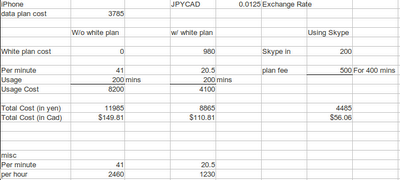 What it means is that for the price of a new iPhone I can reduce my monthly calling costs (and have 2x more minutes) and have an unlimited data plan for the same price as my old plan on my old provider.
I don't know about you, but barring quality of service problems, this looks like a winning plan to me.
$100!). This is clearly unacceptable and I have started looking into getting a data plan for my cell phone.On an interesting note, data packets for cell phones are a major ripoff. My carrier, charges 0.2 yen / 128 bytes (1 packet), this pretty much equates to 1638.4 yen for 1 MB (1024^2 for 1 MB), or about $20 for 1 MB on the go. This is astronomically expensive!
Considering that a 400x320 jpeg is about 100 kb, I am paying about $2 for an image being sent to me. Compare that to a $1 song on iTunes. Wireless carriers are making pretty big margins on their data rates. I do have to wonder how much regulation is keeping new people with fresh ideas out from bringing these costs down.
I have considered adding an unlimited data plan to my cell phone, though it would be a nice feature, I would be missing out on the full richness of having the internet available to me on my mobile device because of its limited user interface. While being back home, I had the opportunity to use the iPhone for an entire week, just using the instant messaging and accessing e-mail here and there has me very enthusiastic about the device and I am seriously considering making the switch.
The new 32 GB iPhone 4 would cost me about $700 and a 16 GB version would run me about $600, I've been looking at the one Japanese iPhone carrier softbank and noted that with a data plan alone, I would be spending about 3785 yen/month for an unlimited data plan and I would be billed per 30 sec for phone calls unless I added a voice plan to make calling "cheaper" --> obviously, the name of the game for softbank is to push the iPhone and it's internet abilities and then quietly sneak in a voice plan.
Now that I understand the name of the game here, if I were to use an iPhone, my goal would be simple-- find a way around using the ordinary voice plan for making calls, because it is really expensive. Without a plan, they charge 41 yen/minute and if you pay an additional 980 yen/month the voice charge is 21 yen/min (using something called a "white plan"). The question is, "can I do better?" and the answer is, (unsurprisingly) yes.
Enter Skype
The ironic thing is that I was looking to get an iPhone to lower my data transfer costs but in actuality I can reduce my voice calling costs significantly by purchasing a skype number for Japan. Buying a skype number with a monthly subscription is 200 yen/month and I am looking at a 400 min subscription for about 500 yen/month. The savings are very significant after the number crunching as shown in the table below.
 What it means is that for the price of a new iPhone I can reduce my monthly calling costs (and have 2x more minutes) and have an unlimited data plan for the same price as my old plan on my old provider.
I don't know about you, but barring quality of service problems, this looks like a winning plan to me.
Thursday, August 26, 2010
I was there before cloud storage
It's been around for a while, but I've started using cloud storage to get access and sync data between several computers: my desktop and my netbook. The service I use is called dropbox and I use it's free 2 GB account to share files between work, home and on the go.
It should be obvious, like having a web based e-mail account that it is nice to have access to your data where ever you are. I used to do this a long time ago while I was a university student, I ran an FTP server so I could upload/download my assignments from home or store work I did at school instead of having to carry a USB memory stick around all the time. I was doing this nearly 7 years ago... and now, having software that lets people store and share data online seems to be fairly decent business.
Being ahead of the curve is one thing, realizing that you're ahead of it and everyone else might have a use for what you do is another. I would never have thought, 7 years ago that people would be interested in having their data accessible from anywhere, because at the time, laptops weren't so hot.
It should be obvious, like having a web based e-mail account that it is nice to have access to your data where ever you are. I used to do this a long time ago while I was a university student, I ran an FTP server so I could upload/download my assignments from home or store work I did at school instead of having to carry a USB memory stick around all the time. I was doing this nearly 7 years ago... and now, having software that lets people store and share data online seems to be fairly decent business.
Being ahead of the curve is one thing, realizing that you're ahead of it and everyone else might have a use for what you do is another. I would never have thought, 7 years ago that people would be interested in having their data accessible from anywhere, because at the time, laptops weren't so hot.
Wednesday, August 04, 2010
Operation Jailbreak
I've worked in the company for long enough and the project I am working on has gotten delayed for some technical difficulties. Some management level people are giving it about 6 months for a redesign and testing. From my perspective it will take 9 months if we are lucky, easily 1 year if we don't have any problems and possibly longer if something bad happens. After that the technology needs to be commercialized, brought to mass production and etc, which will probably take another year or 2. Meaning that it is going to be at least 3 years until a product gets out the door.
It would be nice to have a notch on the belt if this project succeeds, but I don't have forever to wait for things to work. Given market timing sensitivities, other project challenges and even the risk of the project failing, I don't have time to waste for something like that. I want success and I want it now.
There are something that are worth waiting for, but when it comes to putting your life on hold for something that may or may not materialize, what's the point, seriously? You only live once and I'd rather put my time into something more worth while and thus I have decided to start "operation jailbreak."
I think I am done with the 9-5 work life (which actually is more towards the 9-7 pm) , I can do the job and I am properly equipped for the job but the job isn't inspiring or rewarding enough and I don't think that I am producing something that is tangible to me. It's a nice to have but I really don't care about the thing that we are developing, putting in 3 more years of my life into this project isn't worth it, it means that I need an out.
Moving on, new plans:
A job is like being in a relationship, a friend of mine once mentioned to me that when you start to think that it's over, it probably was... 2 months ago. The job makes me money, but it doesn't bring me a sense of accomplishment, pride or joy. It doesn't add additional tangible value to my life other than money, I want a to be free and happy. If being rich ends up being a side of affect of attaining these goals, so be it... but I am not going to sacrifice being "free and happy" for a secondary objective.
Fortunately for me I've been keeping good track of my finances and I know what I need to be making to survive and generally how much I need to make to meet long term goals. What I have not added to the my life plans is an image of what exactly the kind of life that I want to live. The most important thing to me is to reduce the number of hours and be able to take time off whenever I want instead of being at the whim of some company.
There are other lifestyles out there that are more free and open allowing me to spend time more thinking and studying instead of working at an office all day. To be honest, I don't want to think of "work" as "work" anymore, but rather as "something worth doing, well." For me, (and I do not know for others) when I do something worth doing, I will spend the long hours laboring to do something well. I used to do this when I taught classes while at university, I did find some of the practical applications of what I was learning to be genuinely fascinating and I wanted to bring the same level of interest to inspire my peers. I was usually quite well known for my seminars when I was a graduate student. I miss those, as I haven't had the right kind of environment or people to do these kinds of things to do with anyone anymore, hence forth I've gotten a little rusty with my presentation skills. I've also been slacking with writing on the blog, which has been impacting my writing skills. But I digress...
The new long term goals:
The new goals are to work less and remain financially stable. The idea of working in a company is incongruent with my first goal and thus I will be looking to quit and go my own way in the future. Instead of an abrupt change out from my current working situation, I will be looking to pull a fade out by looking to generate "passive income". The goal will be to start by generating $50/weekday, then move up to $100/day and then to $200/day. I think these are realistic goals. Passive income at about $200/day over a year should equate to about $48k/year. If I can pull something like this off, then I am going to be pretty damn happy.
There are several avenues that I want to explore for this so I'll be dedicating my off hours to cultivating skills to make this a reality.
It would be nice to have a notch on the belt if this project succeeds, but I don't have forever to wait for things to work. Given market timing sensitivities, other project challenges and even the risk of the project failing, I don't have time to waste for something like that. I want success and I want it now.
There are something that are worth waiting for, but when it comes to putting your life on hold for something that may or may not materialize, what's the point, seriously? You only live once and I'd rather put my time into something more worth while and thus I have decided to start "operation jailbreak."
I think I am done with the 9-5 work life (which actually is more towards the 9-7 pm) , I can do the job and I am properly equipped for the job but the job isn't inspiring or rewarding enough and I don't think that I am producing something that is tangible to me. It's a nice to have but I really don't care about the thing that we are developing, putting in 3 more years of my life into this project isn't worth it, it means that I need an out.
Moving on, new plans:
A job is like being in a relationship, a friend of mine once mentioned to me that when you start to think that it's over, it probably was... 2 months ago. The job makes me money, but it doesn't bring me a sense of accomplishment, pride or joy. It doesn't add additional tangible value to my life other than money, I want a to be free and happy. If being rich ends up being a side of affect of attaining these goals, so be it... but I am not going to sacrifice being "free and happy" for a secondary objective.
Fortunately for me I've been keeping good track of my finances and I know what I need to be making to survive and generally how much I need to make to meet long term goals. What I have not added to the my life plans is an image of what exactly the kind of life that I want to live. The most important thing to me is to reduce the number of hours and be able to take time off whenever I want instead of being at the whim of some company.
There are other lifestyles out there that are more free and open allowing me to spend time more thinking and studying instead of working at an office all day. To be honest, I don't want to think of "work" as "work" anymore, but rather as "something worth doing, well." For me, (and I do not know for others) when I do something worth doing, I will spend the long hours laboring to do something well. I used to do this when I taught classes while at university, I did find some of the practical applications of what I was learning to be genuinely fascinating and I wanted to bring the same level of interest to inspire my peers. I was usually quite well known for my seminars when I was a graduate student. I miss those, as I haven't had the right kind of environment or people to do these kinds of things to do with anyone anymore, hence forth I've gotten a little rusty with my presentation skills. I've also been slacking with writing on the blog, which has been impacting my writing skills. But I digress...
The new long term goals:
The new goals are to work less and remain financially stable. The idea of working in a company is incongruent with my first goal and thus I will be looking to quit and go my own way in the future. Instead of an abrupt change out from my current working situation, I will be looking to pull a fade out by looking to generate "passive income". The goal will be to start by generating $50/weekday, then move up to $100/day and then to $200/day. I think these are realistic goals. Passive income at about $200/day over a year should equate to about $48k/year. If I can pull something like this off, then I am going to be pretty damn happy.
There are several avenues that I want to explore for this so I'll be dedicating my off hours to cultivating skills to make this a reality.
Tuesday, August 03, 2010
The Entrepreneur
I don't know if it is a good thing, but it seems like that I've been tagged as the entrepreneur at work due to skills in programming and data mining stuff I've been able to do. Basically I am stuck in a group of experimental researchers and I've got the power to write my own programs to analyze vast amounts of data and run simulations that can help predict the outcomes of their experiments.
It took me 2 days to write a simple program to analyze how light would interact with interfaces using snell's law to predict that they'd have problems as a result of their design-- it took them 2 months to build the device to realize that it has problems and are trying like hell to fix it. They've probably used more than $100k in capital in R&D costs to get these results too. I've been doing a lot of these things on the side so the co-workers to get kind of surprised when I throw out these programs from out of nowhere at them. The result of this has given me a bit of an entrepreneurial reputation-- as in if I see something interesting, I'll go off and make something happen. I've started talking business from time to time, by adding new features to equipment that we already have and compared it to other systems that we would have paid a fair bunch of cash if we were to buy equipment that had the stuff loaded in already. People are starting to catch on about me writing valuable software and are kind of poking at me in the sense that I'd probably be able to pull off a software venture.
In a sense, that is a part of the game plan that I want to be positioning myself in the future as I want to leverage my skills to create a money making machine. I just need some spare time to continue building and completing some side projects, then move them online and make them semi-public. If something catches on, commercialize it by selling a subscription or a license or something.
There are a few ideas bouncing around in my head at the moment and not a whole lot of people over that I've found with the same kind of spirit here. Actually, I should start looking into entrepreneurial gatherings in Japan to see what kind of people in that world exists. The project that I am working on just got delayed for about a year and I don't want to be waiting forever until when this thing ships.
I want results, now!
It took me 2 days to write a simple program to analyze how light would interact with interfaces using snell's law to predict that they'd have problems as a result of their design-- it took them 2 months to build the device to realize that it has problems and are trying like hell to fix it. They've probably used more than $100k in capital in R&D costs to get these results too. I've been doing a lot of these things on the side so the co-workers to get kind of surprised when I throw out these programs from out of nowhere at them. The result of this has given me a bit of an entrepreneurial reputation-- as in if I see something interesting, I'll go off and make something happen. I've started talking business from time to time, by adding new features to equipment that we already have and compared it to other systems that we would have paid a fair bunch of cash if we were to buy equipment that had the stuff loaded in already. People are starting to catch on about me writing valuable software and are kind of poking at me in the sense that I'd probably be able to pull off a software venture.
In a sense, that is a part of the game plan that I want to be positioning myself in the future as I want to leverage my skills to create a money making machine. I just need some spare time to continue building and completing some side projects, then move them online and make them semi-public. If something catches on, commercialize it by selling a subscription or a license or something.
There are a few ideas bouncing around in my head at the moment and not a whole lot of people over that I've found with the same kind of spirit here. Actually, I should start looking into entrepreneurial gatherings in Japan to see what kind of people in that world exists. The project that I am working on just got delayed for about a year and I don't want to be waiting forever until when this thing ships.
I want results, now!
Sunday, August 01, 2010
An experiment with dictation software
Today I am using dictation software to write this next blog post. As of recently, I've been trying to improve my typing skills but so far have not come out with any major gains in typing speed and or accuracy. While reading on the Internet if have come across information about people whom write books using dictation software. I decide to give a program called Dragon Naturally Speaking a shot to see what it would be like to dictate a blog post instead of typing one. To be honest it feels very natural to speak and have a blog post written, however it does take some getting used to when it comes to dictating punctuation.
Another thing that would be useful is to have a good microphone with very little noise as it seems that I have some noise issues when it comes to having my speech converted into text, but I don't think this is a very significant problem as these mistakes can be very easily corrected through the keyboard. All in all I do believe that dictating these blog posts over microphone seem to be significantly faster than my typing speed as paragraphs can easily appear in large blocks as the computer processes through the speech and generates text.
So for the time being I went to give speech to text dictation a shot for my blog posts for now and see how that goes. It would also be an interesting experiment to try is to have a wireless microphone and be able to dictate while lying down in bed which it seems like something fun to do.
I live in a dorm room with one of the walls made of wood which unfortunately limits the volume of my voice at which I can speak, so I will be probably limiting so my blog posting to the early evenings until I move out somewhere where I can speak whenever I feel like; it is one of the unfortunate things about living in Japan but I have come to live with it.
So until next time.
Another thing that would be useful is to have a good microphone with very little noise as it seems that I have some noise issues when it comes to having my speech converted into text, but I don't think this is a very significant problem as these mistakes can be very easily corrected through the keyboard. All in all I do believe that dictating these blog posts over microphone seem to be significantly faster than my typing speed as paragraphs can easily appear in large blocks as the computer processes through the speech and generates text.
So for the time being I went to give speech to text dictation a shot for my blog posts for now and see how that goes. It would also be an interesting experiment to try is to have a wireless microphone and be able to dictate while lying down in bed which it seems like something fun to do.
I live in a dorm room with one of the walls made of wood which unfortunately limits the volume of my voice at which I can speak, so I will be probably limiting so my blog posting to the early evenings until I move out somewhere where I can speak whenever I feel like; it is one of the unfortunate things about living in Japan but I have come to live with it.
So until next time.
Saturday, July 24, 2010
Success, is measured in happiness
I wonder about the purpose of money and work sometimes, why is it that so many people decide to get stuck into the rat race of earning money to buy that house, raise kids and then look back after they're old to have survived such a tough obstacle course. I really do wonder if this is the way that people were really meant to live. To be honest, measuring success and happiness by the metrics of income, how much you've saved and the things you've bought are meaningless if you aren't happy. And if there is one thing that many modern cultures are short of, it is exactly that.
I find it ironic that in so many developed countries, that are so efficient, clean and prosperous end up having so many people that are over-worked and stressed out surviving the daily grind. Why is it that so many people are sent through so many years of grueling education, rack up so much debt and have to work like crazy to raise a family. Why is it that finding solace, peace and comfort are considered as luxuries. I cannot understand that mentality.
What is the purpose of life anyways? To each their own answers, but the only answer for me is to do the things that make me happy. I measure my quality of life by joys from the things I do and experience. And I've come to the realization that everything that is worth doing are the things that either brings or helps me attain those happy moments. And when I start viewing the world and everything I've been doing though this outlook, things start to make a lot of sense.
Real value, real happiness. The things worth doing.
There is so much needless stuff in the world today, sometimes I wonder if our culture has some how become fixated that it is necessary to produce more and more for us to consume and use is a good thing. I hear this all the time on the news and on economic reports, how a growing economy is a good thing, how people spending more money and how there are more jobs for people is supposed to be a good thing. I don't know about you, I'd rather not be working if I can help it.
We are obsessed with making and selling things, like somehow we need these things to survive. I've backpacked throughout SE asia once and it is quite amazing at how little one really needs to survive. All I really needed to survive for 3 months was contained in a single suitcase that I dragged around with me. When I look around in my room right now, with all the things in my room, I know that I could be happy with less. Some of my best experiences in life was when I was living as a backpacker, with nearly no possessions. As least for me, I know that I don't need a lot of possessions to be happy and as a result, I sometimes wonder why do we spend so much time and effort making things that we probably don't need. I can't say that the way that I want to live and the values I have might not be right for everyone, but at least from this perspective, we shouldn't be wasting time doing needless things.
If we are caught up with so many things that are superficial, what are the things worth doing then? To which I would answer "whatever makes you happy, in the long run." I add that caveat because there are activities that can bring short-term happiness while trading off long-term happiness, but like a lazy professor writing a university text book, I leave that as an exercise for the reader to figure out. If finding happiness to me and to others are the things really worth doing, it would be obvious that basing a business that offers something tangible to the quality of life to others is a recipe for success.
I find it ironic that in so many developed countries, that are so efficient, clean and prosperous end up having so many people that are over-worked and stressed out surviving the daily grind. Why is it that so many people are sent through so many years of grueling education, rack up so much debt and have to work like crazy to raise a family. Why is it that finding solace, peace and comfort are considered as luxuries. I cannot understand that mentality.
What is the purpose of life anyways? To each their own answers, but the only answer for me is to do the things that make me happy. I measure my quality of life by joys from the things I do and experience. And I've come to the realization that everything that is worth doing are the things that either brings or helps me attain those happy moments. And when I start viewing the world and everything I've been doing though this outlook, things start to make a lot of sense.
Real value, real happiness. The things worth doing.
There is so much needless stuff in the world today, sometimes I wonder if our culture has some how become fixated that it is necessary to produce more and more for us to consume and use is a good thing. I hear this all the time on the news and on economic reports, how a growing economy is a good thing, how people spending more money and how there are more jobs for people is supposed to be a good thing. I don't know about you, I'd rather not be working if I can help it.
We are obsessed with making and selling things, like somehow we need these things to survive. I've backpacked throughout SE asia once and it is quite amazing at how little one really needs to survive. All I really needed to survive for 3 months was contained in a single suitcase that I dragged around with me. When I look around in my room right now, with all the things in my room, I know that I could be happy with less. Some of my best experiences in life was when I was living as a backpacker, with nearly no possessions. As least for me, I know that I don't need a lot of possessions to be happy and as a result, I sometimes wonder why do we spend so much time and effort making things that we probably don't need. I can't say that the way that I want to live and the values I have might not be right for everyone, but at least from this perspective, we shouldn't be wasting time doing needless things.
If we are caught up with so many things that are superficial, what are the things worth doing then? To which I would answer "whatever makes you happy, in the long run." I add that caveat because there are activities that can bring short-term happiness while trading off long-term happiness, but like a lazy professor writing a university text book, I leave that as an exercise for the reader to figure out. If finding happiness to me and to others are the things really worth doing, it would be obvious that basing a business that offers something tangible to the quality of life to others is a recipe for success.
Thursday, July 22, 2010
Time flies
Didn't have a time to relax tonight. I just never realized that things have gotten a little busy and that time is a very valuable.
Finished work at 7:15 pm, dashed out to the super market to buy some groceries, wanted to pick up some new clothes and hangars but the stores were closed, came home to cook, eat and cleaned. Unpacked a bunch of new clothing (26 pieces, a hell of a shopping spree!), removed old clothing from the wardrobe and spent about an hour organizing my internet bookmarks and testing out an online syncing program.
It's already 2:00 am and I still got work tomorrow.
Life feels like a battle against time now. Gotta try and make the best use of what time I have to get things done.
Finished work at 7:15 pm, dashed out to the super market to buy some groceries, wanted to pick up some new clothes and hangars but the stores were closed, came home to cook, eat and cleaned. Unpacked a bunch of new clothing (26 pieces, a hell of a shopping spree!), removed old clothing from the wardrobe and spent about an hour organizing my internet bookmarks and testing out an online syncing program.
It's already 2:00 am and I still got work tomorrow.
Life feels like a battle against time now. Gotta try and make the best use of what time I have to get things done.
Tuesday, July 20, 2010
Long weekend in Hakodate (mainly food pics)
We had a long weekend in Japan this week, so I took the liberty of taking an extra day off to do some traveling in the southern part of Hokkaido (the most northern island of Japan). A good friend of mine goes out there quite often and offered to show me around; so of course, I accepted.
 Hakodate, located fairly south of Hokkaido
Hokkaido was one of the last developed island in Japan and has a lot of European influence after the opening of the Japanese ports to the rest of the world. Hokkaido itself is a fairly sparse island, rich with forests and nature. The seafood out there is also exceptionally good and I was fortunate to have had first hand experience to verify this.
I spent 4 days traveling around Hakodate. I considered going to Hakodate via plane but unfortunately all the cheap flights were booked up so quick that I didn't have a chance, so I arranged to take a train out there. A 1 way trip from Yokohama to Hokkaido spanning 850 km covered in about 7 hours over land. Meaning I had an average speed of over 100 km/h, the train network in Japan is pretty amazing.
Unfortunately, I was so busy traveling, eating and driving around that I didn't have much time to take a lot of pictures but I'll post the few that I have.
Hakodate isn't particularly huge city but has a population of close to 290,000 people. There aren't many tall buildings which added a country side feeling to the city. The city itself is located right by the ocean bringing in a variety of good seafood to the city and I had the chance to go visit one of their seafood markets.
 One shot of the fish market
 The huge scallops they had for sale
 Seafood bought at the local market and eaten as Sashimi for dinner
 Hokke (a type of mackerel) baked with salt in an oven
 You'd never guess that grilled shitake mushrooms could look so good
 Hakodate, located fairly south of Hokkaido
I spent 4 days traveling around Hakodate. I considered going to Hakodate via plane but unfortunately all the cheap flights were booked up so quick that I didn't have a chance, so I arranged to take a train out there. A 1 way trip from Yokohama to Hokkaido spanning 850 km covered in about 7 hours over land. Meaning I had an average speed of over 100 km/h, the train network in Japan is pretty amazing.
Unfortunately, I was so busy traveling, eating and driving around that I didn't have much time to take a lot of pictures but I'll post the few that I have.
Hakodate isn't particularly huge city but has a population of close to 290,000 people. There aren't many tall buildings which added a country side feeling to the city. The city itself is located right by the ocean bringing in a variety of good seafood to the city and I had the chance to go visit one of their seafood markets.
One shot of the fish marketThe huge scallops they had for sale I can personally attest to the greatness of eating fresh seafood in Hakodate compared to Tokyo-- the seafood in Hakodate tastes as fresh as it is good.
Seafood bought at the local market and eaten as Sashimi for dinnerYou'd never guess that grilled shitake mushrooms could look so goodI'd write so much more about the trip and the great nature out there too, but there's only so much time I have tonight. The seafood was one of the best highlights of Hakodate. More pictures can be found on my online album here.
Friday, July 09, 2010
Changing the recipe and learning to do things better
The project is starting to stall. One of the teams is having a hell of a time getting the device working. They changed too many things too quickly and the boss wasn't expecting so many problems. But what else do you expect?

I worked on a different project and just finding a replacement material and then actually using it took about a year to get things to where they are now. The team wants to change the entire design and keep all the previous good characteristics of the old design and have the whole thing done in half a year. Unfortunately that didn't work out. The lead time to make something and then have things tested is much longer then that.

The problem with semiconductor processing is that it is a long drawn out process to make something. When things do work, however, it can be quite amazing. I think there are possibilities for big changes in the industry if the R&D aspects of developing new devices can be
significantly sped up.

The problem with semiconductor device R&D is that a lot of expensive, manual and slow machines are used. Washing and making sample surfaces clean is a 30 minute process and even then, sometimes we have to redo it if some large dust particle falls upon the surface. The patterning
process takes at least 45 mins to 1 hour, depositing metal contact takes about 2 hours. Removing unwanted metal takes probably about another 30 minutes...

Each processing step takes about 1 ~ 3 hours depending on the step and to create a single device, there are at least 40~50 steps. While processing the semiconductor material, it is also important to check the wafers as they go through the machines to make sure nothing goes
wrong, and if strange does happen, it is important to figure out the causes. With all the checking and debugging steps going on, it easily takes 3~4 weeks to finish a batch of devices and then send them into evaluation. After evaluation, the results are fed back into the process team and the cycle restarts. It takes about 2 months to feed back data and have new results. The catch is also that for the devices that I am making, the process is relatively short.

A crucial part to commercializing new technology is to have a R&D department that can rapidly carry out new experiments and get results with blazing fast speed, because in research it is a race to see who is the first able to develop something new for commercialization. The problem about working in R&D is that people exist in a bubble. In order to prevent leaks, there isn't a whole lot of cross talking going on unless you have friends in different departments that know what is going on. When it comes to knowing what is going on in other companies, you are going to have no clue because of strict secrecy.

The interesting thing is that there are big surprises to be had when it comes to corporations competing against each other in research. Basically the ones that are the most creative, the best equipped (and by this, I do not mean by having the most expensive equipment) and the fastest are the ones that will win when it comes to coming to market with new technology. The thing is that both party will have no idea how each group goes about doing their work.

The good thing about working in the R&D department of a large corporation is that they have a lot of money to throw around (as an aside, materials for use in R&D is generally 2~3x more expensive, the mark up via suppliers must be huge) and that they can spent plenty of cash for new equipment. The problem is that most of the equipment is pretty standard stuff and there is a lot of room for improvement to make the machines we use more efficient at getting things done.

I believe that my biggest gripe about the R&D process that I know so far is that companies are willing to invest in equipment to get things done, but there isn't a lot of people in the field that consider how to do things better. If there are companies out there that can make tools to do semiconductor R&D better then there is good money to be made here.

The problem however, is knowing how to get your foot into the door. As an outsider, most companies are too secreteive about their research projects to let anyone else know what is going on to develop things that might be useful, but at the same time, not knowledgeable enough to
develop equipment to do research better. It's a catch-22 problem and one of these conditions have to give before faster advancements in semiconductor technology can be achieved.

The only solution I can think of now is for a company to hold their own R&D semiconductor processing line and invest actively in improving how it is used internally for research, because without more openness, it is going to be hard to innovate in this field. The only company actively doing this that I can think of is Intel.

There is always the academic route (universities), the problem however, is that universities are usually underfunded when it comes to wanting to innovate in this area.
Thursday, July 08, 2010
A fascinating but obvious idea
I don't know how you might feel about wearing used jewelry but with economic times the way they are right now, the concept of renting jewelry sounds like a very reasonable idea to me. An online company called Adorn is doing exactly that with an online catalog and where they just ship the jewelry to you and then you mail it back when you are done. It make perfect sense because most people don't usually wear really fancy jewelry on regular occasions and after a while, wearing the same thing over and over again might get a little boring.
So what if you or your significant other could wear something nice but different everytime? I think this is a brilliant idea, especially in the current economic times. If this really does catch on, I really wonder what impact will it have on companies like De Beers and Tiffany's.
So what if you or your significant other could wear something nice but different everytime? I think this is a brilliant idea, especially in the current economic times. If this really does catch on, I really wonder what impact will it have on companies like De Beers and Tiffany's.
Wednesday, July 07, 2010
Keep up with the right new things
When it comes to getting older, we build up a lot of habits. Not all of these habits are bad things, but it's just how we get used to getting particular things done-- why do something new when the usual method works? And thus, is the recipe for a long and gradual transformation from tech savvy wiz kid to grand-pa trying to figure out how the internet works.
I've been living in a bit of a bubble for the past few years as I've been doing my best to keep my expenses low and spend my time out on the weekends enjoying the outdoors.
I've started looking back into the venture business and technological world to see what's been going on, and I am starting to see a lot of what I have been predicting in the past starting to take shape: advanced information filtering and automation of tedious tasks (mainly in the e-commerce sector). The companies that are starting up are doing a good job of making good user interfaces and bringing down the barrier to making e-commerce sites to allow people to sell goods online. The business models for these online companies providing these design and hosting tools are also making good money utilizing server farms as their infrastructure bases.
Brilliant moves, I should have seen this coming earlier. There is good money to be made with "software as a service" and online content distribution. You won't see big IPOs for these start ups just yet-- they don't need that much money to get off the ground. If you want in on this market, you're going to have to do it on your own or the right group of friends.
I've been living in a bit of a bubble for the past few years as I've been doing my best to keep my expenses low and spend my time out on the weekends enjoying the outdoors.
I've started looking back into the venture business and technological world to see what's been going on, and I am starting to see a lot of what I have been predicting in the past starting to take shape: advanced information filtering and automation of tedious tasks (mainly in the e-commerce sector). The companies that are starting up are doing a good job of making good user interfaces and bringing down the barrier to making e-commerce sites to allow people to sell goods online. The business models for these online companies providing these design and hosting tools are also making good money utilizing server farms as their infrastructure bases.
Brilliant moves, I should have seen this coming earlier. There is good money to be made with "software as a service" and online content distribution. You won't see big IPOs for these start ups just yet-- they don't need that much money to get off the ground. If you want in on this market, you're going to have to do it on your own or the right group of friends.
Monday, July 05, 2010
Pick a few things and be good at them
There is nothing wrong with having a broad skill set, I probably have one that is overly too broad. I know a lot about a lot of general topics but not enough to be really good at most of the things that I do. Some of the things that I excel at are teaching and summarizing information (which sort of go hand in hand) so I have that.
The rest, I just kind of pick things up as I go along and usually get good enough to do something with it. Now when it comes to throwing money on the table and asking someone to pay me to do something, maybe, I don't have enough of what it takes just yet to do things at the level that I want to do.
Nobody wants to pay for something mediocre, even if it is something cheap-- they want the best of whatever for that price range. When it comes to the free market, you have 2 options, either be the best or hope/make sure that no one finds finds anyone better than you (the two are totally different).
In ideal circumstances, the free market would be a meritocratic animal, but in reality it isn't. All I can say is do pick something that you can be really good at, you might end up enjoying it or you'll get the freedom to what you really want through using it.
The rest, I just kind of pick things up as I go along and usually get good enough to do something with it. Now when it comes to throwing money on the table and asking someone to pay me to do something, maybe, I don't have enough of what it takes just yet to do things at the level that I want to do.
Nobody wants to pay for something mediocre, even if it is something cheap-- they want the best of whatever for that price range. When it comes to the free market, you have 2 options, either be the best or hope/make sure that no one finds finds anyone better than you (the two are totally different).
In ideal circumstances, the free market would be a meritocratic animal, but in reality it isn't. All I can say is do pick something that you can be really good at, you might end up enjoying it or you'll get the freedom to what you really want through using it.
Goal: Generate $500 in passive income/month
For some reason, I was feeling kind of tired and bored at work today. I usually end up spending atleast 2~3 hours in over time at work, but decided to go home early. It's 6:15 pm right now and it feels great to be home early-- it actually feels like I have an evening to do something on my own now.
The truth is that I get paid fairly decently for doing over time work and with my boss's permission I am able to log up to 55 hours/month, which is a great help financially, since it significantly increases my savings rate. Though I haven't written about it, I would argue that a person's savings rate is a very strong indicator of a person's financial health.
Though working hard and saving lots of money is a good thing, I am paying for this feat in time and right now, I am starting to value my time more and more over money. So what I would like to do is to start supplementing my main income with a passive income stream to cut down on my overtime hours so I can have my evenings to myself and allow me to work less.
My goals are to find ways of attaining this with a minimal investment cost so I will be looking toward either financial tools or producing something in the software domain that I can sell passively online.
The truth is that I get paid fairly decently for doing over time work and with my boss's permission I am able to log up to 55 hours/month, which is a great help financially, since it significantly increases my savings rate. Though I haven't written about it, I would argue that a person's savings rate is a very strong indicator of a person's financial health.
Though working hard and saving lots of money is a good thing, I am paying for this feat in time and right now, I am starting to value my time more and more over money. So what I would like to do is to start supplementing my main income with a passive income stream to cut down on my overtime hours so I can have my evenings to myself and allow me to work less.
My goals are to find ways of attaining this with a minimal investment cost so I will be looking toward either financial tools or producing something in the software domain that I can sell passively online.
Sunday, June 27, 2010
Being too comfortable is a bad thing
I have come to the realization that I've been living too much of a cushy life and it is having a bad impact on my "drive." I can't think of the antonym of the word "apathetic" at the moment so I'll use drive for the time being.
Things are just too cushy for me and it is too easy for me to just simply exist. It also having a negative impact on my ambition. Sometimes I used to wonder what is it that continually drives these ultra rich CEOs like Bill Gates, Steve Jobs and etc one after making billions of cash. Money simply isn't the motivating factor anymore. It is often confused that ambition is some how linked to making money, but often that it isn't the case-- many ambitions can be accomplished with the help of money. I think it is a concept that gets confused quite often.
Knowing how to follow your heart
My mind works in scientific manner, in that I generally use logic to work things out. Sometimes, some gut feelings are thrown in to the mix when it comes to being creative and coming up to new ideas. But when things are boiled down, we are simply applying these processes and sometimes we forget to ask ourselves what ends are we trying to achieve.
What I have realized after getting into the workforce is that it is easy to forget for what reasons are we working for, or even if we had reasons for getting into what we are doing in the first place. You've graduated and you're on your own now, it's now time to for you to make it on your own now and the problem is that it is too easy to get focused on surviving. Wake up, work, pay the bills, take 2 days off on the weekend-- lather, rinse and repeat. There is more to life to this and after spending a pleasant day chatting with friends and working out at home, I suddenly became pissed off.
My biggest beef is that I should be getting more out of my life and that I should be less tolerant of myself being complacent with just going along with the flow.
What are your deepest wants?
I believe that people are defined by their deepest wants. I get bored meeting new people and when I ask them "so what do you enjoy doing" and they respond with "well, I dunno." I get bored real fast. Seriously then, do you have a reason to exist?
One of my favorite movies is Fight Club. It's a fucking brilliant movie. My favorite scene is where Tyler Durden sticks up the convenience store, simply to scare the shit out of the clerk because he stopped going to vet school because it was too hard.
My favorite quote from the movie was right after the scene with Tyler's monologue:
One of the best experiences of my life is leaving Canada. I find it ironic that I would find leaving one of the livable cities in the world to live somewhere else to be a good thing. But there are things that I have learned on my journeys that I would have never learned by staying at home. The thing about learning how to travel is that you know that your time is limited, thus you make the best of that limited time by doing the most you can. This is how I should be living my life everyday.
When I came to Japan, I ended up being more traveled compared to many of the Japanese that lived here, simply because it felt like I was traveling instead of living here. The ironic thing is that I split an apartment with a Japanese guy that lived in Canada for about a year and he was far more traveled than I was. For the 24 years when I lived in Canada, the furthest I've ever traveled was to Toronto. I've never really seen Banff or Niagra Falls. When I lived in Canada, it just felt like that I could go there whenever I wanted. When you start living like that, you'll end up not doing things.
Your heart will want to take you to strange places
The most ingrained thing of our youths is how our we would be taught to not have dreams off the beaten path. From a survivability point of view and of a parent it makes sense because it is what they are most focused on at the moment. Paying down the mortgage and raising kids is tough work, not that I have kids or a house... I've just done the calculations so I know in advance. But the thing is that values change depending on your age and the conditions you live in, the problem is that people don't do a good job of appreciating this idea--as if values are something unwavering and set in stone. They do change and you've probably not noticed it.
There is more to life than just surviving and it is quite often the part of life that gets forgotten, because sometimes the things that we want are strange... not strange as in weird, but simple different from everyone else. Maybe one person's dream is to be a musician and another's is to travel the world. I cannot answer why we want the things that we do or why you want something different from what I want, but despite wanting different things I can recognize the common things that we share is that happiness is linked to getting what we want.
It's better to try and fail instead of not trying at all
This should be obvious and Shakespeare had his head screwed on straight when it came to love, but this applies to everything else in life as well. I'm not going to make any guarantees that you are going to succeed in everything you do-- you probably are going to fail at something and you will, I guarantee it. The more important thing is if you can keep on going despite failing. If there is a barometer to knowing how/when to take a risk it should simply be that-- for those that have played Texas Hold'em poker, you know what exactly I am talking about.
How much are you willing to lose, how much can you lose?
I think that one thing that isn't really appreciated is knowing how much we can actually afford to lose and still keep on going-- there are so many thing in our lives that simply aren't necessary, but we are still too afraid of losing our so called "creature comforts." After living in Japan for a while, I've already ditched the TV and love living life without it. I can cut back on eating out and bring down my food costs significantly by cooking cheap but healthy meals. I can cut down my expenses further by cutting out expenses for going out for drinks. If I need really cheap housing, sharing an apartment is an option. When push comes to shove, I know I can bring my living expenses way down, bring living expenses down to
So my advice to young adults right now:
Failing isn't the end of the world, success is knowing how to survive failure. While you're unmarried and without kids, these are going to be the freest years of your life. If you want to try something big, this is going to be your only shot. Use it wisely, never be complacent.
Things are just too cushy for me and it is too easy for me to just simply exist. It also having a negative impact on my ambition. Sometimes I used to wonder what is it that continually drives these ultra rich CEOs like Bill Gates, Steve Jobs and etc one after making billions of cash. Money simply isn't the motivating factor anymore. It is often confused that ambition is some how linked to making money, but often that it isn't the case-- many ambitions can be accomplished with the help of money. I think it is a concept that gets confused quite often.
Knowing how to follow your heart
My mind works in scientific manner, in that I generally use logic to work things out. Sometimes, some gut feelings are thrown in to the mix when it comes to being creative and coming up to new ideas. But when things are boiled down, we are simply applying these processes and sometimes we forget to ask ourselves what ends are we trying to achieve.
What I have realized after getting into the workforce is that it is easy to forget for what reasons are we working for, or even if we had reasons for getting into what we are doing in the first place. You've graduated and you're on your own now, it's now time to for you to make it on your own now and the problem is that it is too easy to get focused on surviving. Wake up, work, pay the bills, take 2 days off on the weekend-- lather, rinse and repeat. There is more to life to this and after spending a pleasant day chatting with friends and working out at home, I suddenly became pissed off.
My biggest beef is that I should be getting more out of my life and that I should be less tolerant of myself being complacent with just going along with the flow.
What are your deepest wants?
I believe that people are defined by their deepest wants. I get bored meeting new people and when I ask them "so what do you enjoy doing" and they respond with "well, I dunno." I get bored real fast. Seriously then, do you have a reason to exist?
One of my favorite movies is Fight Club. It's a fucking brilliant movie. My favorite scene is where Tyler Durden sticks up the convenience store, simply to scare the shit out of the clerk because he stopped going to vet school because it was too hard.
My favorite quote from the movie was right after the scene with Tyler's monologue:
"Tomorrow will be the most beautiful day of Raymond K. Hessel's life. His breakfast will taste better than any meal you and I have ever tasted. "Many people who've had a near death experience usually walk away with a new lease on life-- maybe because they've realized that there are many things that they still want to do, but haven't yet. For those of us that haven't had an experience like that, I think that we forget that we all are dying, day by day-- time isn't something that shouldn't be taken for granted.
One of the best experiences of my life is leaving Canada. I find it ironic that I would find leaving one of the livable cities in the world to live somewhere else to be a good thing. But there are things that I have learned on my journeys that I would have never learned by staying at home. The thing about learning how to travel is that you know that your time is limited, thus you make the best of that limited time by doing the most you can. This is how I should be living my life everyday.
When I came to Japan, I ended up being more traveled compared to many of the Japanese that lived here, simply because it felt like I was traveling instead of living here. The ironic thing is that I split an apartment with a Japanese guy that lived in Canada for about a year and he was far more traveled than I was. For the 24 years when I lived in Canada, the furthest I've ever traveled was to Toronto. I've never really seen Banff or Niagra Falls. When I lived in Canada, it just felt like that I could go there whenever I wanted. When you start living like that, you'll end up not doing things.
Your heart will want to take you to strange places
The most ingrained thing of our youths is how our we would be taught to not have dreams off the beaten path. From a survivability point of view and of a parent it makes sense because it is what they are most focused on at the moment. Paying down the mortgage and raising kids is tough work, not that I have kids or a house... I've just done the calculations so I know in advance. But the thing is that values change depending on your age and the conditions you live in, the problem is that people don't do a good job of appreciating this idea--as if values are something unwavering and set in stone. They do change and you've probably not noticed it.
There is more to life than just surviving and it is quite often the part of life that gets forgotten, because sometimes the things that we want are strange... not strange as in weird, but simple different from everyone else. Maybe one person's dream is to be a musician and another's is to travel the world. I cannot answer why we want the things that we do or why you want something different from what I want, but despite wanting different things I can recognize the common things that we share is that happiness is linked to getting what we want.
It's better to try and fail instead of not trying at all
This should be obvious and Shakespeare had his head screwed on straight when it came to love, but this applies to everything else in life as well. I'm not going to make any guarantees that you are going to succeed in everything you do-- you probably are going to fail at something and you will, I guarantee it. The more important thing is if you can keep on going despite failing. If there is a barometer to knowing how/when to take a risk it should simply be that-- for those that have played Texas Hold'em poker, you know what exactly I am talking about.
How much are you willing to lose, how much can you lose?
I think that one thing that isn't really appreciated is knowing how much we can actually afford to lose and still keep on going-- there are so many thing in our lives that simply aren't necessary, but we are still too afraid of losing our so called "creature comforts." After living in Japan for a while, I've already ditched the TV and love living life without it. I can cut back on eating out and bring down my food costs significantly by cooking cheap but healthy meals. I can cut down my expenses further by cutting out expenses for going out for drinks. If I need really cheap housing, sharing an apartment is an option. When push comes to shove, I know I can bring my living expenses way down, bring living expenses down to
$800~$1000/month. At this level of income, even a $7/hour job for 8 hours/day can sustain this life at bare minimum, with a university degree, you can easily do better.So my advice to young adults right now:
Failing isn't the end of the world, success is knowing how to survive failure. While you're unmarried and without kids, these are going to be the freest years of your life. If you want to try something big, this is going to be your only shot. Use it wisely, never be complacent.
Wednesday, June 23, 2010
Uproar against Oprah
So Opera is running a contest to find the next TV talk show host, though usually I wouldn't care for these things one of the entrants has proposed an excellent idea and seems to be a really honest down to earth guy. His name is Zach Anner, a 20-something year old guy with cerebral palsy and has an enticing video about traveling, his video entry is here.
The contest supposedly began around May 14th, 2010 with a site allowing people to put in submissions for videos and there will be live casting calls involved. But to the heart of the whole issue, is that Zach Anner went viral by June 14th. Interestingly with help by 4chan and social websites like reddit and has hit 3 million votes. Interestingly out comes a unknown entrant going by Dr. Phyllis and her entry is here. Earlier today Dr. Phyllis was leading Zach Anner by a ~200,000 votes, which is odd considering someone with very little web presence. Ironically the people at 4chan, enraged by the whole ordeal has spread news of the vote rigging, started voting campaigns only to find that Dr. Phyllis to continue to lead. In short, what we are seeing right now is blatant vote rigging by Oprah's website, and I have a feeling that Dr. Phyllis was Oprah's favorite from the beginning to have her own show.
Democracy against totalitarianism at it's best. Apparently 4chan is pissed and has started "Operation SyPhyllis", involving macros to start auto-voting but it seems their votes are going elsewhere. They are, exceptionally pissed. I am really curious to see where this drama goes. One of the reasons why, it is hypothesized that Zach might not be the "right candidate" for a show hosted by Oprah is that he wouldn't cater to the demographics of her brand (housewives) as opposed to people like Dr. Phyllis, whom is a black lady in her middle ages. Seriously, 5 million votes for Dr. Phyllis over 1 month!? That would be at least 170,000 votes/day and Zach is at 4.7 million now. For those 2 alone Oprah's site would need at least 300k visitors/day, just for those 2 contestants alone and assuming a 100% voting rate. There is no way that Oprah's website would naturally generate that much traffic and I would honestly call bullshit on the whole thing.
Personally, I stand with Zach Anner because I liked his video think that he would be awesome on a show. For a guy with cerebral palsy to come so far is admirable and I am not a huge fan of Oprah right now. So I hope things play out like this:
The contest supposedly began around May 14th, 2010 with a site allowing people to put in submissions for videos and there will be live casting calls involved. But to the heart of the whole issue, is that Zach Anner went viral by June 14th. Interestingly with help by 4chan and social websites like reddit and has hit 3 million votes. Interestingly out comes a unknown entrant going by Dr. Phyllis and her entry is here. Earlier today Dr. Phyllis was leading Zach Anner by a ~200,000 votes, which is odd considering someone with very little web presence. Ironically the people at 4chan, enraged by the whole ordeal has spread news of the vote rigging, started voting campaigns only to find that Dr. Phyllis to continue to lead. In short, what we are seeing right now is blatant vote rigging by Oprah's website, and I have a feeling that Dr. Phyllis was Oprah's favorite from the beginning to have her own show.
Democracy against totalitarianism at it's best. Apparently 4chan is pissed and has started "Operation SyPhyllis", involving macros to start auto-voting but it seems their votes are going elsewhere. They are, exceptionally pissed. I am really curious to see where this drama goes. One of the reasons why, it is hypothesized that Zach might not be the "right candidate" for a show hosted by Oprah is that he wouldn't cater to the demographics of her brand (housewives) as opposed to people like Dr. Phyllis, whom is a black lady in her middle ages. Seriously, 5 million votes for Dr. Phyllis over 1 month!? That would be at least 170,000 votes/day and Zach is at 4.7 million now. For those 2 alone Oprah's site would need at least 300k visitors/day, just for those 2 contestants alone and assuming a 100% voting rate. There is no way that Oprah's website would naturally generate that much traffic and I would honestly call bullshit on the whole thing.
Personally, I stand with Zach Anner because I liked his video think that he would be awesome on a show. For a guy with cerebral palsy to come so far is admirable and I am not a huge fan of Oprah right now. So I hope things play out like this:
- Zach Anner loses to an Oprah "favorite"
- The internet, news and tabloids go into an uproar
- Oprah is ridiculed
- Some other network seeing the value of Zach picks him up
- Zach's show rocks
- Oprah selected favorite starts her show and bombs
Saturday, June 19, 2010
Updated the blogger template
I've updated the blogger template from the old version that I was using. I was somewhat shy of updating since there were a bunch of custom changes I made to the old template to make it more viewer friendly on wider screens. The defaults for the older templates had the blog rather narrow, so I changed the parameters to make things wider. I also have a hit counter installed just for kicks though I don't really care about the volume I get to this site, I wasn't sure that things would still work after the upgrade.
While writing the last post, I thought it would be nice to embed some mathematical equations and I did manage to find an applet that would let me do that my interpreting LaTeX code to do the formatting. Previously, I used to do the writing in the MS Equation Editor in Word. The problem now is that I don't use Word at home so that option was out. I did find something nice here that I installed and it worked decently. I've never used LaTeX before, but it seemed rather easy to figure out and I had it going after a little bit of testing.
I am not much of a front end webpage designer so I do kind of shy away from that kind of stuff, but if I am to dive into the database programming stuff and consider interfacing that to webpages, it is something to look into in the future.
While writing the last post, I thought it would be nice to embed some mathematical equations and I did manage to find an applet that would let me do that my interpreting LaTeX code to do the formatting. Previously, I used to do the writing in the MS Equation Editor in Word. The problem now is that I don't use Word at home so that option was out. I did find something nice here that I installed and it worked decently. I've never used LaTeX before, but it seemed rather easy to figure out and I had it going after a little bit of testing.
I am not much of a front end webpage designer so I do kind of shy away from that kind of stuff, but if I am to dive into the database programming stuff and consider interfacing that to webpages, it is something to look into in the future.
A plot of Yield vs Bond Prices
Been sick for the last week so I've decided to take the weekend off from social activities and spend it at home. There is only so much time one can spend in bed so I've gotten out of bed and decided to get back into some programming and study some finance. I decided to do some basic study in bonds since it seemed simple enough, at least compared to learning options and Black-Scholes equation (I have a basic understanding of the formula, it's just an implementation and testing problem and writing software to make calculations easier).
The mathematics of modeling bond prices is fairly simple using a discounted cash flow (DCF) model based on some internal rate of return (IRR). Basically, a bond is a security with (or without) a fixed interest payment at some interval (annually, semi-annually or quarterly) and finally the redemption of the bond at the end of the term. Calculating and comparing the value of one bond against others requires the comparison of yield to decide if you want to select one bond over another.
In mathematical notation the DCF for the present value of cash flow is summarized as:
The mathematics of modeling bond prices is fairly simple using a discounted cash flow (DCF) model based on some internal rate of return (IRR). Basically, a bond is a security with (or without) a fixed interest payment at some interval (annually, semi-annually or quarterly) and finally the redemption of the bond at the end of the term. Calculating and comparing the value of one bond against others requires the comparison of yield to decide if you want to select one bond over another.
In mathematical notation the DCF for the present value of cash flow is summarized as:
$\color{white}PV =\sum_{t}P_t(1+IRR)^-^t$
Where:
This is of course is possible to do in Excel with the use of its solver module. The problem, however is tedious when you want to calculate over a range of possible bond prices to understand the sensitives of yield vs bond prices as the solver needs to be rerun for every bond price and every IRR needs to be saved and then plotted for.
With a bit of some spare time on my hands, I decided to write a simple solver and plot over a range of different bond prices to understand the relationship of yield vs bond price over 3 different bond interest (coupon?) rates for a 5 year bond. The result is illustrated in the graph below (click for a larger view):
 What this graph illustrates is the inverse relationship between yield and price of a bond. The higher the cost of a bond, the lower the yield, which of course should be obvious when you think about it since you get less return when you pay more to buy a bond.
The graph also explains the cursory impact of Federal Bank interest rates on the bond market-- what it means is that increasing interest rates will generally force bond prices lower because future cash flows are valued less with higher interest rates. The reverse is also true when interest rates are decreased, bringing bond prices upwards.
Though quantitative valuation of bond pricing can be done mathematically to get nice numbers, investors must also be confident with the company to repay its bonds. Confidence or risk is also a factor affects the yield of a bond. Companies that are considered low risk, generally garner lower yields as there is stronger demand for their bonds thus pushing the price of the bond upwards. Companies that are considered riskier generally have less demand and their bond prices tend to be lower. The market in this sense sets the interest rate at which a company borrow cash as the yields for newly written bonds must be at least equal or greater than the bonds being currently traded-- if yields are lower than currently traded bonds, then there is no incentive to buy the new bonds.
There are inherent dangers of relying strictly on mathematical models for bond pricing as the qualitative aspects of bond pricing, mainly the confidence factor is not well represented in the numerical analysis and this is a source of significant risk. The recent economic crisis had also caused a crash in the bond market as confidence for many companies to continually repay their debt dropped, leading to depressed bond prices and an opportunity to acquire bonds with very high yields, so long as you were able to pick the correct companies.
Though it would be smart to sell of bond assets before an economic crash, bonds appear to be fairly safe so long as the underlying company does not go bankrupt or default. Supposing that you bought a 5 year bond just before for a decent yield at 7% or something before an economic crash and assume that the company is well off enough to survive for at least the next 5 years, you are guaranteed to get your money back with interest when the bond matures. For the matter of equities, you have no guarantees if stock prices will recover within that time span. In this regard, bonds are fairly stable when compared to buying stock equity.
The next step will be to find sources of data on where I can look up the specific details of bonds on the market, in addition to their payment schedule to refine and develop more accurate pricing calculations. I assume that many quants have done this already since the bond pricing is time sensitive as a result of the DCF model. The birth of "snatching nickels from under a steam roller" was a result of quants trying to pick up small profits through arbitration in the bond markets... however the amount of capital that had to be moved around to pick up these small "nickels" was immense, meaning that sudden large movements in the bond market would be catastrophic if an institution was caught. Some of the details of this can be found in Black Swan, a book by Taleb.
- $\color{white}P_t$ is the cash flow at some point in time $\color{white}t$
- $\color{white}IRR$ is the internal rate of return
- $\color{white}PV$ is the present value of all future cash flows
This is of course is possible to do in Excel with the use of its solver module. The problem, however is tedious when you want to calculate over a range of possible bond prices to understand the sensitives of yield vs bond prices as the solver needs to be rerun for every bond price and every IRR needs to be saved and then plotted for.
With a bit of some spare time on my hands, I decided to write a simple solver and plot over a range of different bond prices to understand the relationship of yield vs bond price over 3 different bond interest (coupon?) rates for a 5 year bond. The result is illustrated in the graph below (click for a larger view):
 What this graph illustrates is the inverse relationship between yield and price of a bond. The higher the cost of a bond, the lower the yield, which of course should be obvious when you think about it since you get less return when you pay more to buy a bond.
The graph also explains the cursory impact of Federal Bank interest rates on the bond market-- what it means is that increasing interest rates will generally force bond prices lower because future cash flows are valued less with higher interest rates. The reverse is also true when interest rates are decreased, bringing bond prices upwards.
Though quantitative valuation of bond pricing can be done mathematically to get nice numbers, investors must also be confident with the company to repay its bonds. Confidence or risk is also a factor affects the yield of a bond. Companies that are considered low risk, generally garner lower yields as there is stronger demand for their bonds thus pushing the price of the bond upwards. Companies that are considered riskier generally have less demand and their bond prices tend to be lower. The market in this sense sets the interest rate at which a company borrow cash as the yields for newly written bonds must be at least equal or greater than the bonds being currently traded-- if yields are lower than currently traded bonds, then there is no incentive to buy the new bonds.
There are inherent dangers of relying strictly on mathematical models for bond pricing as the qualitative aspects of bond pricing, mainly the confidence factor is not well represented in the numerical analysis and this is a source of significant risk. The recent economic crisis had also caused a crash in the bond market as confidence for many companies to continually repay their debt dropped, leading to depressed bond prices and an opportunity to acquire bonds with very high yields, so long as you were able to pick the correct companies.
Though it would be smart to sell of bond assets before an economic crash, bonds appear to be fairly safe so long as the underlying company does not go bankrupt or default. Supposing that you bought a 5 year bond just before for a decent yield at 7% or something before an economic crash and assume that the company is well off enough to survive for at least the next 5 years, you are guaranteed to get your money back with interest when the bond matures. For the matter of equities, you have no guarantees if stock prices will recover within that time span. In this regard, bonds are fairly stable when compared to buying stock equity.
The next step will be to find sources of data on where I can look up the specific details of bonds on the market, in addition to their payment schedule to refine and develop more accurate pricing calculations. I assume that many quants have done this already since the bond pricing is time sensitive as a result of the DCF model. The birth of "snatching nickels from under a steam roller" was a result of quants trying to pick up small profits through arbitration in the bond markets... however the amount of capital that had to be moved around to pick up these small "nickels" was immense, meaning that sudden large movements in the bond market would be catastrophic if an institution was caught. Some of the details of this can be found in Black Swan, a book by Taleb.
Thursday, June 17, 2010
The Database is King
Databases are a pain to manage. Follow this guy, I he's a good guy and has plenty of good ideas. It's a breath of fresh air from most of the chaff I've been reading on the net recently.
I have been working on a database problem for quite some time now, I just never realized it when it came to building a simple stock market analysis program. I pretty much wrote a simple database system to store my data and run queries against it. It came apparent after I started separating my query code from the data to make analyzing data cleaner.
I started reading more and more about new startups coming online on the net, the kind that the guy I like to follow, Paul Graham seems to like to write about. He doesn't post as much as he used to on his website anymore, he seems to have gone underground into different networks, instead of appearing to the net as a whole, but to a more targeted audience of hackers instead. He posts more regularly here instead.
Many of the growing start ups he has been funding recently has been oriented on providing services through a amazon's server network. The more I think about it, it seems to be a hot bed for many new information management systems built specifically for many different niches and I am starting to see a big variation of similar themes.
You don't need a huge server farm anymore and you pay for whatever you need when you need it. The setup is amazingly simple. The database is pretty damn amazing stuff and it had pretty good applications in social online products.
I need to pick up some database skills, for 2 reasons:
1. The company I work for could use a hand in databasing their experimental data and tracking
2. I could spin off my skills to dive into the world of online data management and figure out to monetize my skills.
Jason L Bapteste, an excellent writer with good brains on his head mentions that Excel is the world's more used "Database." I agree with him after seeing how we (as researchers) manage our data, that is plenty of room for improvement here, especially when it comes to querying data. Recent versions of excel has brought in more and more databasing functionality on sort of a "lite" kind of scale, but there is most definitely a demand for it.
I have been working on a database problem for quite some time now, I just never realized it when it came to building a simple stock market analysis program. I pretty much wrote a simple database system to store my data and run queries against it. It came apparent after I started separating my query code from the data to make analyzing data cleaner.
I started reading more and more about new startups coming online on the net, the kind that the guy I like to follow, Paul Graham seems to like to write about. He doesn't post as much as he used to on his website anymore, he seems to have gone underground into different networks, instead of appearing to the net as a whole, but to a more targeted audience of hackers instead. He posts more regularly here instead.
Many of the growing start ups he has been funding recently has been oriented on providing services through a amazon's server network. The more I think about it, it seems to be a hot bed for many new information management systems built specifically for many different niches and I am starting to see a big variation of similar themes.
You don't need a huge server farm anymore and you pay for whatever you need when you need it. The setup is amazingly simple. The database is pretty damn amazing stuff and it had pretty good applications in social online products.
I need to pick up some database skills, for 2 reasons:
1. The company I work for could use a hand in databasing their experimental data and tracking
2. I could spin off my skills to dive into the world of online data management and figure out to monetize my skills.
Jason L Bapteste, an excellent writer with good brains on his head mentions that Excel is the world's more used "Database." I agree with him after seeing how we (as researchers) manage our data, that is plenty of room for improvement here, especially when it comes to querying data. Recent versions of excel has brought in more and more databasing functionality on sort of a "lite" kind of scale, but there is most definitely a demand for it.
Friends as filters
The same cycle repeats itself. First you have a small community of smart people, then it gets noticed and then the quality of the community drops like a rock after too many people want to join it. The same thing happens for real life communities, real-estate and online communities.
I frequent many socially aggregated websites, mainly places like reddit and slashdot. I've been hanging around there since the beginning of reddit and I have to admit that the quality of postings over there during the first few years was great. Now after the 4th or 5th year of the site being live and it catering to a very wide audience, there is a whole lot of uninteresting crap that gets posted out there. If you know anything about the LOL cat meme, then you know what I mean.
Digg, another social link aggregation site suffers the same problem and started which ironically, caused more of the "intelligent" users to move over to reddit, (there are sources out there on the net and I don't feel like doing the linking at the moment since I just want to get this post done).
The web 2.0 phenomenon was a great hit at first, as it got the social web started. I would venture a bet that it was first the technologically savvy and intelligent people that caught on first that that created the valuable communities which spured this movement; and now everyone and their dog can get into these communities which has changed the dynamics considerably.
What I believe next to happen is the anti-thesis of web 2.0, which is the creation of the filtered internet, and ideally it is you that decides what to filter, most notably, the golden needle from the hay.
This is an idea, which I believe will outlive the open, aggregated websites like Digg, Reddit and Slashdot, which is also open to corruption by people gaming these sites (ie with vote bots and etc).
Instead, I propose/expect to see vetted communities of people that can aggregate for good information. I believe that this phenomenon is also being (had been) repeated on Facebook, where the community used to be only university students and now, even your boss might be able to see what you've been up to... the vetting begins with the privacy controls to other people.
I think we will eventually start to move away from these sites and develop our own aggregation systems... starting with our friends.
I frequent many socially aggregated websites, mainly places like reddit and slashdot. I've been hanging around there since the beginning of reddit and I have to admit that the quality of postings over there during the first few years was great. Now after the 4th or 5th year of the site being live and it catering to a very wide audience, there is a whole lot of uninteresting crap that gets posted out there. If you know anything about the LOL cat meme, then you know what I mean.
Digg, another social link aggregation site suffers the same problem and started which ironically, caused more of the "intelligent" users to move over to reddit, (there are sources out there on the net and I don't feel like doing the linking at the moment since I just want to get this post done).
The web 2.0 phenomenon was a great hit at first, as it got the social web started. I would venture a bet that it was first the technologically savvy and intelligent people that caught on first that that created the valuable communities which spured this movement; and now everyone and their dog can get into these communities which has changed the dynamics considerably.
What I believe next to happen is the anti-thesis of web 2.0, which is the creation of the filtered internet, and ideally it is you that decides what to filter, most notably, the golden needle from the hay.
This is an idea, which I believe will outlive the open, aggregated websites like Digg, Reddit and Slashdot, which is also open to corruption by people gaming these sites (ie with vote bots and etc).
Instead, I propose/expect to see vetted communities of people that can aggregate for good information. I believe that this phenomenon is also being (had been) repeated on Facebook, where the community used to be only university students and now, even your boss might be able to see what you've been up to... the vetting begins with the privacy controls to other people.
I think we will eventually start to move away from these sites and develop our own aggregation systems... starting with our friends.
Tuesday, June 15, 2010
Midnight already
This is post 500. Over the last 5 years of doing this blog, I average about 1 post every 3 days.
I will admit that the writing quality and the depth of analysis that I've been doing recently has gone down significantly recently. It is sometimes said that the productive prime of one's life is when you're at 27. I am now 2 years past that prime and perhaps we might be seeing this effect occurring. Maybe it's also the lack of time that I have to do any significant writing/thinking either. I used to be able to get away with making blog posts from my desk at university, now making blog posts from work is kind of sketchy... but anyways, I digress.
Today, I finished work about 8:30 ish and came home where I did my usual exercise routine, took a shower, organized some photos and cleaned off my computer desk. By the time I had everything done, it's already midnight. It's amazing how quickly time flies, the passage of time is really different now that I've gotten older- it is a peculiar thing.
It just means that I am going to have to work harder to make every second count. After getting my room all cleaned up, I'll be looking into cutting out activities where I end up wasting my time doing nothing productive.
I will admit that the writing quality and the depth of analysis that I've been doing recently has gone down significantly recently. It is sometimes said that the productive prime of one's life is when you're at 27. I am now 2 years past that prime and perhaps we might be seeing this effect occurring. Maybe it's also the lack of time that I have to do any significant writing/thinking either. I used to be able to get away with making blog posts from my desk at university, now making blog posts from work is kind of sketchy... but anyways, I digress.
Today, I finished work about 8:30 ish and came home where I did my usual exercise routine, took a shower, organized some photos and cleaned off my computer desk. By the time I had everything done, it's already midnight. It's amazing how quickly time flies, the passage of time is really different now that I've gotten older- it is a peculiar thing.
It just means that I am going to have to work harder to make every second count. After getting my room all cleaned up, I'll be looking into cutting out activities where I end up wasting my time doing nothing productive.
Monday, June 14, 2010
S3, The scalable platform
I got interested about how other large websites host data on the internet a few days ago and started poking around... eventually I found myself at Amazon's S3 website. It is Amazon's cloud computing service which basically allows anyone to sign up and use Amazon's scalable storage and computing clusters.
The idea of cloud computing hit a chord with me. Basically without much capital investment, it is possible to have a fairly formidable online web presence at somewhat of a decent price. Storage at $0.15/GB month for the first 50 TB, $0.15 /GB out and $0.10/GB. Suppose that you store 1 GB and transfer it in and out during a single month. That movement of data would have cost you $0.40 and subsequently $0.15 more for every time the data is shipped out.
Let's ignore costs for storing data and incoming data (because I will assume that you are a data distributor), the question is can you make more than $0.15/GB that you dish out? If you can, then you've got a money making machine.
The next question is, what kind of data would someone want to pay for?
The idea of cloud computing hit a chord with me. Basically without much capital investment, it is possible to have a fairly formidable online web presence at somewhat of a decent price. Storage at $0.15/GB month for the first 50 TB, $0.15 /GB out and $0.10/GB. Suppose that you store 1 GB and transfer it in and out during a single month. That movement of data would have cost you $0.40 and subsequently $0.15 more for every time the data is shipped out.
Let's ignore costs for storing data and incoming data (because I will assume that you are a data distributor), the question is can you make more than $0.15/GB that you dish out? If you can, then you've got a money making machine.
The next question is, what kind of data would someone want to pay for?
A simple playlist generator?
I talked before about liking the iTunes genius playlist generator. It's a step in the right direction, but it is still kind of unwieldy when it comes to making music lists. Sometimes, the exact same group of music is always played together all the time and that doesn't add much musical variety to the playlists generated. I would like playlists automatically generated for whatever the occasion that I am feeling like. Something fast? Acoustic? Folk? Whatever?
The interesting thing is that music selection can be sort of dealt with using a markov chain kind of analysis. The computations might be really intensive since the transition matrix does tend to get really big, but it is a really simple "dumb" way of figuring out what kind of music that should be played together without directly analyzing the content of the music itself.
The point about the Genius playlist generator is that you send all your music data to apple, where it sorts through the ID tags of the music you have and then generates some kind of connection tree back for your iPod and then playlists are automatically generated based on that data. There are several problems with this since not all music might be listed in their database, thus certain songs will be forever left out of your automatically generated music mix. The other problem is since that I am on a linux based machine, I can't use iTunes and I don't want to use iTunes through a virtual machine because it is slow.
The open source music playlist generators right now are OK, but I still find them lacking a little still. I've started using a plug in for Banshee that does the playlist generation. I just use an initial song for the things to start. Sometimes it is tricky to pick something and I don't really like that. If I could pick from a mood or a genre, that would be nice.
There is room for improvement here and it might be an interesting problem to work on.
The interesting thing is that music selection can be sort of dealt with using a markov chain kind of analysis. The computations might be really intensive since the transition matrix does tend to get really big, but it is a really simple "dumb" way of figuring out what kind of music that should be played together without directly analyzing the content of the music itself.
The point about the Genius playlist generator is that you send all your music data to apple, where it sorts through the ID tags of the music you have and then generates some kind of connection tree back for your iPod and then playlists are automatically generated based on that data. There are several problems with this since not all music might be listed in their database, thus certain songs will be forever left out of your automatically generated music mix. The other problem is since that I am on a linux based machine, I can't use iTunes and I don't want to use iTunes through a virtual machine because it is slow.
The open source music playlist generators right now are OK, but I still find them lacking a little still. I've started using a plug in for Banshee that does the playlist generation. I just use an initial song for the things to start. Sometimes it is tricky to pick something and I don't really like that. If I could pick from a mood or a genre, that would be nice.
There is room for improvement here and it might be an interesting problem to work on.
Must reduce clutter
I have come to the conclusion that I have way to much junk in my room and life in general, thus leading to way too much management overhead. Having too much overhead gets in the way of making decisions and getting things done, so I have decided to start by slowly getting rid of things that I don't use so that I can focus on the essentials better.
The first thing I am going to do is start getting rid of junk in my room, clear off the tables and organize for only the essentials. After that, I'll be going through the computer to organize my data and start trashing things that I don't need.
Finally, I need to go through my cell phone contact list and start organizing it and get rid of contacts that I never contact and keep a list of people that I regularly want to contact.
I'll be trying to do this over the span of a week so I'll see how this goes.
The first thing I am going to do is start getting rid of junk in my room, clear off the tables and organize for only the essentials. After that, I'll be going through the computer to organize my data and start trashing things that I don't need.
Finally, I need to go through my cell phone contact list and start organizing it and get rid of contacts that I never contact and keep a list of people that I regularly want to contact.
I'll be trying to do this over the span of a week so I'll see how this goes.
2 months into the diet
Been about 2 months into the exercise thing I've been doing and I am finally starting to see some results. For the first month, I've been focused on losing excess fat by changing up the diet, basically cutting out all junk foods and focused my food consumption to lean meats, lots of vegetables and complex carbohydrates. I've basically switched over from white rice to brown rice. Right now, I kind of like brown rice because of the texture and it has some more flavor over plain white rice.
Starting from the beginning of May, I bought an exercise machine which I use every other day for upper body strength training. It's been nearly 1 month of training using that machine and I am now starting to see some muscle development in my shoulders and chest. Growth in the forearms are a little slow texture of my arms have started to become firmer compared to before. I've also lost weight around the waist, which means my pants have started to feel considerably looser and I now require a belt as my pants will start to slide slowly down through the entire day during any walking activity.
The graph below kind of explains my current situation:

I lost about 2 kg (about 4.5 pounds) over the first month, where most of the weight loss occurred during the first 2 weeks of the diet. I was rather surprised at how quickly my body responded to the change in what I've been eating. After the first month, I started weigh training and there has been some fluctuations in body mass and somewhat of a continued downward trend in body mass until day 50, where after there has been an up tick in weight past day 60 and another sharp decline in mass as I close in on day 70. What might be going on is an increase in muscle mass that might be driving the body mass upwards.
On an interesting note, my physical change is having an interesting affect on how I navigate through crowded corridors in downtown Tokyo, especially in the train station. I used to spend time avoiding people around people while walking and now after exercising and getting a little bigger, people have started getting out of my way. I find this rather fascinating.
Starting from the beginning of May, I bought an exercise machine which I use every other day for upper body strength training. It's been nearly 1 month of training using that machine and I am now starting to see some muscle development in my shoulders and chest. Growth in the forearms are a little slow texture of my arms have started to become firmer compared to before. I've also lost weight around the waist, which means my pants have started to feel considerably looser and I now require a belt as my pants will start to slide slowly down through the entire day during any walking activity.
The graph below kind of explains my current situation:

I lost about 2 kg (about 4.5 pounds) over the first month, where most of the weight loss occurred during the first 2 weeks of the diet. I was rather surprised at how quickly my body responded to the change in what I've been eating. After the first month, I started weigh training and there has been some fluctuations in body mass and somewhat of a continued downward trend in body mass until day 50, where after there has been an up tick in weight past day 60 and another sharp decline in mass as I close in on day 70. What might be going on is an increase in muscle mass that might be driving the body mass upwards.
On an interesting note, my physical change is having an interesting affect on how I navigate through crowded corridors in downtown Tokyo, especially in the train station. I used to spend time avoiding people around people while walking and now after exercising and getting a little bigger, people have started getting out of my way. I find this rather fascinating.
Tuesday, June 01, 2010
Been busy
Would like to do more writing but been kind of busy recently. I do come home earlier now a these days but don't spend as much time thinking as I would like. Too many internet distractions to be honest.
Been keeping up with the exercise routine, putting on some muscles now. Pretty happy with the progress.
Also saw a great movie today called Into the wild. released in 2007, but I had just found it recently. Been a long time since I saw a movie that made me stop and pause at the end.
It's past midnight now... had an early day and need sleep. Will get back into writing eventually.
Been keeping up with the exercise routine, putting on some muscles now. Pretty happy with the progress.
Also saw a great movie today called Into the wild. released in 2007, but I had just found it recently. Been a long time since I saw a movie that made me stop and pause at the end.
It's past midnight now... had an early day and need sleep. Will get back into writing eventually.
Monday, May 24, 2010
Points? what points?
When I go shopping, I usually go looking for something I need at the lowest possible price. What I get annoyed at is when I start having to carry point cards or membership cards to get some kind of discount. When I get into a situation like that, my wallet starts to get bloated with more cards than cash and eventually I become generally annoyed with dealing with excess baggage.
I also hate gimmicks where stores make it look like you're saving more cash than you actually are. When I was a kid, I would always be mystified about the idea of a "sale." Something could be "50%" off, but I used to wonder what if these guys just doubled the price and then said that it was "50%" off? Essentially, that is what the retail business is all about-- finding ways of getting people to spend more money.
Air miles, I've never in my life have ever spent an air mile before, but it just seems like one of those big things that you ought to save up for a trip to somewhere or something like that. I ended up getting an air miles card for one of the flight carriers in Japan since I had to fly out to the country side to visit a factory. Free miles, so why not, I thought. I got card in the mail just today and according to the system they have, is that I have to spend $2 to get 1 cents worth of points. In other words, I would have to spend about $20,000 to get a $100 worth of cash back!?
What kind of insane system is that? It just sends the wrong message that you have to spend ridiculous amount of money to just get a little back. I am rather surprised at how some people are so keen on collecting points to get something back, especially when what you get back is so little.
Rather than collecting points, I would believe that there are better ways of spending one's time.
I also hate gimmicks where stores make it look like you're saving more cash than you actually are. When I was a kid, I would always be mystified about the idea of a "sale." Something could be "50%" off, but I used to wonder what if these guys just doubled the price and then said that it was "50%" off? Essentially, that is what the retail business is all about-- finding ways of getting people to spend more money.
Air miles, I've never in my life have ever spent an air mile before, but it just seems like one of those big things that you ought to save up for a trip to somewhere or something like that. I ended up getting an air miles card for one of the flight carriers in Japan since I had to fly out to the country side to visit a factory. Free miles, so why not, I thought. I got card in the mail just today and according to the system they have, is that I have to spend $2 to get 1 cents worth of points. In other words, I would have to spend about $20,000 to get a $100 worth of cash back!?
What kind of insane system is that? It just sends the wrong message that you have to spend ridiculous amount of money to just get a little back. I am rather surprised at how some people are so keen on collecting points to get something back, especially when what you get back is so little.
Rather than collecting points, I would believe that there are better ways of spending one's time.
Thursday, May 20, 2010
Obviously, I am a guy
Just got an e-mail from a female friend tonight CC'd to a bunch of people about how an old lady scolded her when she was sending e-mail from her cell phone by the priority seats. Generally in Japan, most people ignore that rule and no one really minds, except for the old lady in question.
Apparently after being scolded, she sends out an e-mail to her friend how she was kind of depressed about the whole incident and that it would have been nicer if the older lady was a little kinder with her words, though she was explaining how she was trying to be understanding. The e-mail rattles onwards on how it is hard to deal with situations like these... yadda yadda yadda and finally comes to the conclusion, "what would you do?"
I fired off an e-mail in about 5 minutes with 2 lines compared to her essay "Just say sorry and tell the old lady to be a little nicer when telling someone to do something."
After hitting send, I just realized how much of a guy I was: she probably wanted comfort instead of advice. And I get a lot of trouble from that when other girls when they come to me with their problems-- they aren't looking for a solution.
Apparently after being scolded, she sends out an e-mail to her friend how she was kind of depressed about the whole incident and that it would have been nicer if the older lady was a little kinder with her words, though she was explaining how she was trying to be understanding. The e-mail rattles onwards on how it is hard to deal with situations like these... yadda yadda yadda and finally comes to the conclusion, "what would you do?"
I fired off an e-mail in about 5 minutes with 2 lines compared to her essay "Just say sorry and tell the old lady to be a little nicer when telling someone to do something."
After hitting send, I just realized how much of a guy I was: she probably wanted comfort instead of advice. And I get a lot of trouble from that when other girls when they come to me with their problems-- they aren't looking for a solution.
When rules get in the way of work
I can't say for certain if this is a good or bad thing, but one thing that really annoys me about work is how managers like rules especially when something goes wrong (no matter how benign).
Just a few days ago, I made a small mistake that basically killed a sample. I opened a bottle of resin a little to close to one of my samples and unfortunately it squirted on to the sample, thus ruining it. Fortunately I had a spare sample to replace the ruined one. I figured that I would just make a mental note to not do that again.
Since these samples I am working on are being passed through a manual labor processing line, I naturally reported in on the little mishap and informed the people in charge that I'll be replacing the sample with another equivalent one. Apparently that wasn't enough.
Management type people aren't involved first hand with what is going on, so when I told them about the problem, they weren't necessarily satisfied that I just replaced the sample. They wanted some action-plan to thus prevent this kind of problem from ever happening again. The first one manager suggested to me was what about having a rule where you should open the bottle at least 1 meter away from the sample. Seriously.
What turned out to be a small mistake which could be remedied by having the sample put on a shelf nearby for when I open the bottle, I ended up having to spend a few hours taking photos of the work space and writing a power point presentation with a play-by-play of how some resin got splashed onto a sample. Bloody waste of time in my opinion, where as I could be off doing some productive work instead.
I sort of feel for these managers though, it seems that because these guys are in a position of power (perhaps?) that they have a need to get actively involved in making decisions or that they are involved some how in getting something implemented (albeit from a sort of distant kind of manner). Honestly, sometimes they should just learn to stand back and let the front line people deal with the problem instead.
The problem with the need for counter-measures and loads of preventative rules (though I would not say that they are all bad) is that it gets in the way of getting real work done. This is actually one blaring weakness when it comes to wanting to get work done. The best managers that I have worked for are the ones that do their best to shield us from dealing with all these annoying rules and simply let us have our way (within reasonable means of course). Because when I have to start following a gazillion rules to reduce errors that happen on a 1 out 100 probability that suck up my time, it becomes a pain in the ass to get anything done.
The ironic thin instead is that one of the guys that I am working with now has decided that it would be much better in our interests to just not report small problems and deal with them ourselves instead of wasting our time taking photos and writing up reports of benign events, which probably won't add up to brownie points on a performance review.
The moral of the story? Don't report small issues, just successes. Though it might not be how things should be setup, it's just more "cost effective" for people like me working in this kind of environment.
Just a few days ago, I made a small mistake that basically killed a sample. I opened a bottle of resin a little to close to one of my samples and unfortunately it squirted on to the sample, thus ruining it. Fortunately I had a spare sample to replace the ruined one. I figured that I would just make a mental note to not do that again.
Since these samples I am working on are being passed through a manual labor processing line, I naturally reported in on the little mishap and informed the people in charge that I'll be replacing the sample with another equivalent one. Apparently that wasn't enough.
Management type people aren't involved first hand with what is going on, so when I told them about the problem, they weren't necessarily satisfied that I just replaced the sample. They wanted some action-plan to thus prevent this kind of problem from ever happening again. The first one manager suggested to me was what about having a rule where you should open the bottle at least 1 meter away from the sample. Seriously.
What turned out to be a small mistake which could be remedied by having the sample put on a shelf nearby for when I open the bottle, I ended up having to spend a few hours taking photos of the work space and writing a power point presentation with a play-by-play of how some resin got splashed onto a sample. Bloody waste of time in my opinion, where as I could be off doing some productive work instead.
I sort of feel for these managers though, it seems that because these guys are in a position of power (perhaps?) that they have a need to get actively involved in making decisions or that they are involved some how in getting something implemented (albeit from a sort of distant kind of manner). Honestly, sometimes they should just learn to stand back and let the front line people deal with the problem instead.
The problem with the need for counter-measures and loads of preventative rules (though I would not say that they are all bad) is that it gets in the way of getting real work done. This is actually one blaring weakness when it comes to wanting to get work done. The best managers that I have worked for are the ones that do their best to shield us from dealing with all these annoying rules and simply let us have our way (within reasonable means of course). Because when I have to start following a gazillion rules to reduce errors that happen on a 1 out 100 probability that suck up my time, it becomes a pain in the ass to get anything done.
The ironic thin instead is that one of the guys that I am working with now has decided that it would be much better in our interests to just not report small problems and deal with them ourselves instead of wasting our time taking photos and writing up reports of benign events, which probably won't add up to brownie points on a performance review.
The moral of the story? Don't report small issues, just successes. Though it might not be how things should be setup, it's just more "cost effective" for people like me working in this kind of environment.
Tuesday, May 18, 2010
Avoiding distractions
It should be obvious, but distractions are a hell of a productivity killer.
Sometimes I wonder how much more I could get done without being distracted, but alas it only remains a figment of my imagination. I have, for the time being, come to accept my fate for now and instead keep a list of a few things that I need to get done everyday. So long as I get the important things done, anything else I get done is icing on the cake.
The key to success is keeping expectations low?
I would have to disagree with that as some of my most productive and driven times are when there are things that I really want to do. Another way of describing it is "having the right motivation." Where does motivation come from, I do not know. There are times when I have been highly motivated and I would stop at nothing to get something done and there are other times where I could care less. The fickleness of human emotions defies my logical thought.
I used to run on the assumption that as long as I saw a logical reason to doing something then I would have no good reason to no do something. Unfortunately, the human body doesn't work like that. Why is it sometimes that the right thing and the hard thing the same thing? I wake up at 7 am and I know that I probably should get out of bed and do something productive, instead I lie awake until about 8:15 instead. But I think I am straying away from the topic... now what was it... oh yeah, avoiding distractions.
How to not be distracted
The only easy answer I've been able to figure out for my case is simply to not be at home nor at work. As long as I am away from familiar territory, my productivity shoots up like mad. I could probably live traveling through hostel to hostel and spend the days checking out interesting places and then come back and spend hours writing up about the interesting things I've done. I could probably live away in a garage surrounded with cool tools to play with and would probably end up spending hours building something.
Being somewhere comfortable is probably the biggest hindrance to me, simply just because I know how to distract myself in comfortable situations compared to when I am away and need to get things done.
The question is how to bring those qualities into my everyday life.... something I need to figure out.
Sometimes I wonder how much more I could get done without being distracted, but alas it only remains a figment of my imagination. I have, for the time being, come to accept my fate for now and instead keep a list of a few things that I need to get done everyday. So long as I get the important things done, anything else I get done is icing on the cake.
The key to success is keeping expectations low?
I would have to disagree with that as some of my most productive and driven times are when there are things that I really want to do. Another way of describing it is "having the right motivation." Where does motivation come from, I do not know. There are times when I have been highly motivated and I would stop at nothing to get something done and there are other times where I could care less. The fickleness of human emotions defies my logical thought.
I used to run on the assumption that as long as I saw a logical reason to doing something then I would have no good reason to no do something. Unfortunately, the human body doesn't work like that. Why is it sometimes that the right thing and the hard thing the same thing? I wake up at 7 am and I know that I probably should get out of bed and do something productive, instead I lie awake until about 8:15 instead. But I think I am straying away from the topic... now what was it... oh yeah, avoiding distractions.
How to not be distracted
The only easy answer I've been able to figure out for my case is simply to not be at home nor at work. As long as I am away from familiar territory, my productivity shoots up like mad. I could probably live traveling through hostel to hostel and spend the days checking out interesting places and then come back and spend hours writing up about the interesting things I've done. I could probably live away in a garage surrounded with cool tools to play with and would probably end up spending hours building something.
Being somewhere comfortable is probably the biggest hindrance to me, simply just because I know how to distract myself in comfortable situations compared to when I am away and need to get things done.
The question is how to bring those qualities into my everyday life.... something I need to figure out.
Saturday, May 15, 2010
On Touch Typing
I decided recently that I needed to to some practice with my typing as I generally seem to get a little annoyed when I make errors when typing. I generally feel that making a typing mistake and then hitting the backspace key to correct the error to be too much of a pain even to the point that I just keep on going and let spell check deal with the mistakes later on. It just feels really good to keep on going, but it drives me nuts sometimes to see an error just sticking there on the screen that I eventually need to go back and fix it. To alleviate this problem, sometimes I just shut my eyes and just keep going on wit the typing, often to catastrophic effect.
In the old days, you'd usually have to buy software to practice your typing, but now with the internet, there are plenty of places online that you can take lessons for free. I decided to do just that. The first site I came across was here, which was the first site that popped up after a google search for me. So I decided to give it a shot.
My average wpm while for just transcribing text is about 60~70 wpm, but this does not count for errors and going back to fix them (I would assume that my speed would drastically drop once factoring in mistakes). I then tried out their lessons which involves something in the effect of what you might have learned from a touch typing class in high school, which basically is:
1. Hands on the home row
2. Practicing using your index fingers
3. Moving on wards to using the index fingers and middle fingers
4. Using your ring fingers or learning how to go up and down the keyboard
5. Etc
I find that learning how to type like this to be really unnatural to me as my hands and brain doesn't work like this at all. The first lesson where I was just using my index fingers went fine (using the 'F' and 'J' keys), as soon as the program started bringing in my middle fingers into the mix and incorporating the 'D' and 'K' characters into the lesson, I was thrown for a loop. My speed was just ridiculously slow and I had a hell of a hard time trying to get my hands working for me.
I believe that my hands have already some kind of muscle memory built into them as a result of learning to type words whole words instead of gunning for random letters. If I were given a set of random letters to transcribe, I would be at a terrible loss to type them at any sort of speed, where as I would end up being much faster at typing natural words. For example the word "The" I would my left hand only to type this word, though it would probably be more proper to use the right hand for the letter 'H'. I just figured that since my left hand was already doing the typing already, it just felt natural for the hand to do all of the typing.
I type predominantly with my left hand as most of the letters are located on the left hand side of the keyboard and with most of the punctuation located on the right hand side. As a result the span of my left hand is greater than my right hand as I ended up going as far as the letter 'H' with, my left hand and sometimes going as far as the letter 'U' in some cases. For example the word "you," since my index finger has already gotten to the letter "Y", after hitting the "O" my index finger is already beside the the letter "U" so I naturally hit it with my index finger of my left hand. Depending on the context through, I do also hit the letter 'U' with the right hand as well, so a good bunch of the keys that I use are shared between both hands.
If anyone ever bought me one of those ergonomic keyboards, I'd probably take it and kill them with it because it would be utterly useless for me. But still, I think my error rate for typing is still on the high side and with all my years of working on the computer, it still hasn't improved one bit. The question is that do I keep working with the current system that I have right now or do I throw it out and go with standard typing practices.
When I have some more time, I'll try my hand at transcribing written works and see if that helps. If it doesn't then I will consider learning a new typing style. With computers being such an integral part of a person's life it would make sense to have excellent typing skills.
My hand positions are also not fixed as they tend to glide around the keyboard depending on the words that I am using. For example, it would be standard to use just the ring finger to press for the letter "O." In my case, the finger that presses the letter "O" is generally my middle finger as my ring finger tends to be a little hard for me to control and when I do use it, I generally use my ring mainly for the backspace key or the return button.
In the old days, you'd usually have to buy software to practice your typing, but now with the internet, there are plenty of places online that you can take lessons for free. I decided to do just that. The first site I came across was here, which was the first site that popped up after a google search for me. So I decided to give it a shot.
My average wpm while for just transcribing text is about 60~70 wpm, but this does not count for errors and going back to fix them (I would assume that my speed would drastically drop once factoring in mistakes). I then tried out their lessons which involves something in the effect of what you might have learned from a touch typing class in high school, which basically is:
1. Hands on the home row
2. Practicing using your index fingers
3. Moving on wards to using the index fingers and middle fingers
4. Using your ring fingers or learning how to go up and down the keyboard
5. Etc
I find that learning how to type like this to be really unnatural to me as my hands and brain doesn't work like this at all. The first lesson where I was just using my index fingers went fine (using the 'F' and 'J' keys), as soon as the program started bringing in my middle fingers into the mix and incorporating the 'D' and 'K' characters into the lesson, I was thrown for a loop. My speed was just ridiculously slow and I had a hell of a hard time trying to get my hands working for me.
I believe that my hands have already some kind of muscle memory built into them as a result of learning to type words whole words instead of gunning for random letters. If I were given a set of random letters to transcribe, I would be at a terrible loss to type them at any sort of speed, where as I would end up being much faster at typing natural words. For example the word "The" I would my left hand only to type this word, though it would probably be more proper to use the right hand for the letter 'H'. I just figured that since my left hand was already doing the typing already, it just felt natural for the hand to do all of the typing.
I type predominantly with my left hand as most of the letters are located on the left hand side of the keyboard and with most of the punctuation located on the right hand side. As a result the span of my left hand is greater than my right hand as I ended up going as far as the letter 'H' with, my left hand and sometimes going as far as the letter 'U' in some cases. For example the word "you," since my index finger has already gotten to the letter "Y", after hitting the "O" my index finger is already beside the the letter "U" so I naturally hit it with my index finger of my left hand. Depending on the context through, I do also hit the letter 'U' with the right hand as well, so a good bunch of the keys that I use are shared between both hands.
If anyone ever bought me one of those ergonomic keyboards, I'd probably take it and kill them with it because it would be utterly useless for me. But still, I think my error rate for typing is still on the high side and with all my years of working on the computer, it still hasn't improved one bit. The question is that do I keep working with the current system that I have right now or do I throw it out and go with standard typing practices.
When I have some more time, I'll try my hand at transcribing written works and see if that helps. If it doesn't then I will consider learning a new typing style. With computers being such an integral part of a person's life it would make sense to have excellent typing skills.
My hand positions are also not fixed as they tend to glide around the keyboard depending on the words that I am using. For example, it would be standard to use just the ring finger to press for the letter "O." In my case, the finger that presses the letter "O" is generally my middle finger as my ring finger tends to be a little hard for me to control and when I do use it, I generally use my ring mainly for the backspace key or the return button.
Secret Projects and Politics
It is so interesting what people start doing without knowing the full details of what is going on. The project at work is coming to an interesting head with some of the managers worrying if we can pull this thing off as some new obstacles have come into play that may cause some problems with us meeting our deadlines.
Right now, we are relying on another group to go into mass production of parts we need for our project. We have done the initial R&D, but the problem with this other group is that there are still many remaining issues to getting the parts we need at a high enough quality. A deadline will be coming up and some people are uncertain that they will be able to produce the parts, within spec, by the required time.
The development process will be passed onto this other group and we will move on to a different phase of the project and it seems that one of the managers and a few of my colleagues are uncertain about this other group pulling through and they want a risk hedge. The interesting thing is that development of this part, after some internal shuffling has been passed onto me and there has already been some underground improvements and design changes made to a prototype to solve some problems and the new design has been presented. Unfortunately for the new part to be put into the system, we need cooperation with other groups, meaning that the development of this new part cannot be kept secret.
Since there hasn't been too much upper level communication about this project and the real objective of this new design wasn't entirely clear as many people had different objectives in mind, I decided to try and clear things up by going public with the project. Upper management responded that we should halt work on it and save our resources for something else. Personally, I think they are right as a new version of this prototype is coming out and the project is going to switch over to that, but some people are still smacking for some kind of risk hedge and want to continue this current project "underground" and I would have to work on it.
My visibility on the whole project is not broad enough to understand everything that is going on at the moment, but given that we are transferring production to another group and we are close to the end run of production on this end, I don't see how we can produce these new parts, test them and perform feed back in a meaningful way if the design is going to change and we are close to finishing up here. People are worried that the other group may fail and we may have to fall back to the original design and hence we should continue work.
As there are too many unknowns at this point, I think it is kind of imprudent to start pouring resources into a separate project where we do not know the outcome or if it will be needed in the future, especially if I have to do it "underground" and it will cost me additional time out of my evenings to work on this. I also probably will not be able to report on this project and thus when I can't talk about it during my performance review, my efforts cannot really thrown into discussion. There is no incentive for me for in this project and there are to many unknowns that I cannot justify myself into working on this project.
On a second note, if you want to really do an underground project, you also need to have access to all the necessary resources on your own without requiring support of management to pull it off. I am pretty good at running "shoe string" experiments/projects but considering I need resources from other groups and need to schedule things into different lines, it would be hard to keep this project a secret. If someone wants to really do it, I am going to have to tell them to do it themselves.
Right now, we are relying on another group to go into mass production of parts we need for our project. We have done the initial R&D, but the problem with this other group is that there are still many remaining issues to getting the parts we need at a high enough quality. A deadline will be coming up and some people are uncertain that they will be able to produce the parts, within spec, by the required time.
The development process will be passed onto this other group and we will move on to a different phase of the project and it seems that one of the managers and a few of my colleagues are uncertain about this other group pulling through and they want a risk hedge. The interesting thing is that development of this part, after some internal shuffling has been passed onto me and there has already been some underground improvements and design changes made to a prototype to solve some problems and the new design has been presented. Unfortunately for the new part to be put into the system, we need cooperation with other groups, meaning that the development of this new part cannot be kept secret.
Since there hasn't been too much upper level communication about this project and the real objective of this new design wasn't entirely clear as many people had different objectives in mind, I decided to try and clear things up by going public with the project. Upper management responded that we should halt work on it and save our resources for something else. Personally, I think they are right as a new version of this prototype is coming out and the project is going to switch over to that, but some people are still smacking for some kind of risk hedge and want to continue this current project "underground" and I would have to work on it.
My visibility on the whole project is not broad enough to understand everything that is going on at the moment, but given that we are transferring production to another group and we are close to the end run of production on this end, I don't see how we can produce these new parts, test them and perform feed back in a meaningful way if the design is going to change and we are close to finishing up here. People are worried that the other group may fail and we may have to fall back to the original design and hence we should continue work.
As there are too many unknowns at this point, I think it is kind of imprudent to start pouring resources into a separate project where we do not know the outcome or if it will be needed in the future, especially if I have to do it "underground" and it will cost me additional time out of my evenings to work on this. I also probably will not be able to report on this project and thus when I can't talk about it during my performance review, my efforts cannot really thrown into discussion. There is no incentive for me for in this project and there are to many unknowns that I cannot justify myself into working on this project.
On a second note, if you want to really do an underground project, you also need to have access to all the necessary resources on your own without requiring support of management to pull it off. I am pretty good at running "shoe string" experiments/projects but considering I need resources from other groups and need to schedule things into different lines, it would be hard to keep this project a secret. If someone wants to really do it, I am going to have to tell them to do it themselves.
Thursday, May 13, 2010
If I were to give myself advice from the future
It would be this: "Don't Destroy Your Sex Rank By Stupid Educational Choices"
Not to say that I'm not sexy by all means, it just means that I wished I was at my full potential a little earlier ;)
Not to say that I'm not sexy by all means, it just means that I wished I was at my full potential a little earlier ;)
Wednesday, May 12, 2010
Being complacent is not a good thing
Perhaps it is the natural cycle of going from a new recruit in the company to getting used to the surrounding. I used to have a lot of ideas when I first got into the company I was working in. I believed that the R&D process could be sped up immensely by using semi-automation techniques and let the machines we use work through the night producing results that we could evaluate through the day.
I had dreams that I wanted to semi-automate many of the measurement systems and processing systems to make unattended batch processing feasible. Things like that shouldn't be too hard to make, all you need is a sample loader and a mechanism to program in a batch recipe and some error handling (the assumption part is the "all you need" part).
The problem is that with all these ideas, I would have needed the time and resources to put this into action and the problem is that getting the required level of funding and support would have been a pain in the rear. So I but the bullet and decided to work with the system to get the job done like everyone else did.
I personally think that this is the way that many good ideas die, just because people don't have the finding, time or the freedom to give it a shot, because we are stuck work that "needs" to be done and have to little time to do find ways that the current job could be done better or new things to try.
Most of the best ideas and biggest successes came out of skunkworks project, were people were able to make things out of shoe string budgets, putting in their own time to make something. Not everything worked, but some of the biggest successes have been huge. For example, a company like Sony's first venture into the gaming world was not the result of the playstation but by Ken Kutaragi underground working with Nintendo on using the the SPC700 chip that sony developed as Nintendo's sound chip. It was after that that (and must scolding from Sony's executive, that Ken would eventually fire) that Sony got into the console business.
There are probably many examples in history where employees have come up with great ideas that would turn out to be money makers that the executives would never understand. Xerox also had the same problem with the development with the graphical OS and the mouse which Apple and Microsoft would steal for their own computers.
Not all ideas have been good, but so long as the required funds and time is small enough that shouldn't be too much of a problem. If you keep trying, eventually, you'll make a hit. The most important part is the trying, and I believe that companies that don't foster that will probably end up dying.
I had dreams that I wanted to semi-automate many of the measurement systems and processing systems to make unattended batch processing feasible. Things like that shouldn't be too hard to make, all you need is a sample loader and a mechanism to program in a batch recipe and some error handling (the assumption part is the "all you need" part).
The problem is that with all these ideas, I would have needed the time and resources to put this into action and the problem is that getting the required level of funding and support would have been a pain in the rear. So I but the bullet and decided to work with the system to get the job done like everyone else did.
I personally think that this is the way that many good ideas die, just because people don't have the finding, time or the freedom to give it a shot, because we are stuck work that "needs" to be done and have to little time to do find ways that the current job could be done better or new things to try.
Most of the best ideas and biggest successes came out of skunkworks project, were people were able to make things out of shoe string budgets, putting in their own time to make something. Not everything worked, but some of the biggest successes have been huge. For example, a company like Sony's first venture into the gaming world was not the result of the playstation but by Ken Kutaragi underground working with Nintendo on using the the SPC700 chip that sony developed as Nintendo's sound chip. It was after that that (and must scolding from Sony's executive, that Ken would eventually fire) that Sony got into the console business.
There are probably many examples in history where employees have come up with great ideas that would turn out to be money makers that the executives would never understand. Xerox also had the same problem with the development with the graphical OS and the mouse which Apple and Microsoft would steal for their own computers.
Not all ideas have been good, but so long as the required funds and time is small enough that shouldn't be too much of a problem. If you keep trying, eventually, you'll make a hit. The most important part is the trying, and I believe that companies that don't foster that will probably end up dying.
Sunday, May 09, 2010
12 Days of Vacation coming to an end
My vacation is winding down to an end with today being my last day off. It's been a busy vacation, heading out to Sendai, spending time at the hot springs, drinking till the morning, going for lunch, catching the bullet train back, then having drinks with other friends after arriving in Tokyo and then a home party the next day. I've also rode done 3x30 km bike rides out to the beach and back, coupling that with some exercising at home. The body isn't picking up as much muscle as I would like, but I managed to luck out just today with a friend that had a big exercise machine that he wanted to unload.
 A shot of the machine from the front
 A shot from the side, also exposing my messy room
(yes, I keep an oscilloscope in the room)
 A shot of the machine from the front
 A shot from the side, also exposing my messy room
(yes, I keep an oscilloscope in the room)
The machine retails for about $550 and I managed to get this machine used off a friend for about $275. I just finished moving the machine in to my room and it was plenty of work to heave about. The exercise machine can be completely disassembled but we decided to try and move it around largely in one piece. Buying this machine is a great investment as I used to spend about $60/month for a gym subscription that I could only use once a week because of my late working hours.
Now that I have an exercise machine at home, I should be able to squeeze in a 30~45 min round of exercise, then hitting the showers before going to bed. If you are planning to do muscular training for more than a year, then an exercise machine is well worth the investment. Hopefully, I will have some nice muscular development happening over the next few months.
Going off on another tangent, I've been spending a lot of time out recently, that I've found myself to be a lot more productive while spending time out of the home, or away from the computer. There just seems to be too many distractions on the net keeping me from doing productive activities. I will be looking into trying to cut down the amount of time surfing the net and doing productive work in my spare time.
I've found that it helps for me to have a list of things that I should to and pick something from there to do, else I end up vegging out reading webpages instead.
Now that I have an exercise machine at home, I should be able to squeeze in a 30~45 min round of exercise, then hitting the showers before going to bed. If you are planning to do muscular training for more than a year, then an exercise machine is well worth the investment. Hopefully, I will have some nice muscular development happening over the next few months.
Going off on another tangent, I've been spending a lot of time out recently, that I've found myself to be a lot more productive while spending time out of the home, or away from the computer. There just seems to be too many distractions on the net keeping me from doing productive activities. I will be looking into trying to cut down the amount of time surfing the net and doing productive work in my spare time.
I've found that it helps for me to have a list of things that I should to and pick something from there to do, else I end up vegging out reading webpages instead.
Friday, May 07, 2010
The information playing field
The average person is generally at a disadvantage when it comes to good information. Financial institutions, insurance companies, real estate agents, credit card companies are exceptionally keen on getting financial information from the average Joe. Armed with statistical information, one can statistically profile people based on their income, gender and purchasing habits. When it comes to dealing with loans and insurance I believe that the relationship between the institution and the average person is asymmetric.
It would be an interesting experiment to see if this playing field could be leveled though the creation of a database with anonymous (and reliable?) information. The people at Glassdoor have managed to do something similar but different with salary information, though I am not sure how sexy a person's spending data would be.
It would be an interesting experiment to see if this playing field could be leveled though the creation of a database with anonymous (and reliable?) information. The people at Glassdoor have managed to do something similar but different with salary information, though I am not sure how sexy a person's spending data would be.
Surviving is hedging against the stupidity of other people
What you would you do if you had to pick up the tab for someone else's mistake? I would naturally would not be happy about it. In the last few years, we have already seen this happen with both Iceland and now probably Greece. Germany is obviously unhappy with the prospect of having to spend the most money on Greece to bail them out, nor are the Greeks happy that they are going to be on the line for tax increases and pay cuts to pay off a debt that their government managed to hide for so long.
I generally don't really care/mind what other people do so long as it does not negatively affect the well being of other people. I generally try to live by that rule, but what annoys me is when other people start screwing things up for other people and leaving them on the hook for it. As much as I would like people/organizations/politicians to take responsibility for their own mistakes, they usually don't or they can't, especially in the case of a major catastrophe.
I once remarked that for a democracy to work well, you need an educated population. Unfortunately, there are too many uneducated people voting for and getting things that might not be good for them. Changing the ways that people think about anything (finance, politics, etc.) is a hard problem and sometimes it just isn't worth the time and effort to change them. It would be more productive for me to hedge and isolate myself from them whenever I think I am right and they are wrong, in other words "put my money where my mouth is" instead of arguing about "where we should put our money."
I generally don't really care/mind what other people do so long as it does not negatively affect the well being of other people. I generally try to live by that rule, but what annoys me is when other people start screwing things up for other people and leaving them on the hook for it. As much as I would like people/organizations/politicians to take responsibility for their own mistakes, they usually don't or they can't, especially in the case of a major catastrophe.
I once remarked that for a democracy to work well, you need an educated population. Unfortunately, there are too many uneducated people voting for and getting things that might not be good for them. Changing the ways that people think about anything (finance, politics, etc.) is a hard problem and sometimes it just isn't worth the time and effort to change them. It would be more productive for me to hedge and isolate myself from them whenever I think I am right and they are wrong, in other words "put my money where my mouth is" instead of arguing about "where we should put our money."
Wednesday, May 05, 2010
The diet continues
Golden week started as of last week in Japan. It's basically like 3 days of holidays in a row and if you throw in some paid holidays, it can be nicely extended. I managed to do that and turned my golden week holiday into a 12 day string of off time. And it's been great not going to work.
I spent most of golden week meeting up with friends in Tokyo and then heading out to Sendai to hit some hot springs and meet up with friend over there. The last 4 days for me pretty much centered around eating, drinking and sitting hot water. It was pretty good. After getting back to Tokyo I finally managed to weigh myself for the first time in 4 days to find my self rather relieved that I haven't gained any weight.
Interestingly, I have found that my body weight does swing in about a 1.0 kg range depeneding on if I weigh myself right after some vigorous exercise or after taking in a big meal with plenty of fluids. I spent about 1.5 hours riding out and back from where I live to a beach, with a round trip total distance of 30 km. After the ride I weighed 66.7 kg and then after taking in some dinner and fluids throughout the day, I currently weigh 67.6 kg. I need to take a look at my body weight trend for a little longer to decide on what I need to do next to bring myself further into shape. Attached below is the most recent body weight trend data.
 I have also decided to do some calculations about my caloric intake since I have just been eyeballing things recently using the calculator provided at nutrition data. As of recent, I've been eating mostly a combination of a home brew of chili, a soup based on sole fish, assorted vegetables (broccoli, spinach, cabbage, corn, carrots, peas and seaweed) and rice. I've approximated my portion sizes and according to the calculator, I am consuming bout 1052 Calories, of which 149 Calories come from fat as shown in the summary below.
 I believe that the real value for my caloric intake is probably a little higher since I do tend to eat 1 extra meal in the day as I usually feel hunger pangs since going on this diet. My caloric intake is significantly lower compared to my 1600 Calorie goal, though I believe that my real caloric intake is higher, it should be in the 1300~1500 Calorie range as I am sneaking in some fruits and servings of vegetables to deal with the hunger pangs.
If my caloric intake remains too low, I might switch over from consuming white rice to brown(ish) rice, which is a kind of rice without the outer husk polished off. It is often said to be more healthy but I am not entirely sure why most rice producers like to polish off the brown outer layers from the rice.
I spent most of golden week meeting up with friends in Tokyo and then heading out to Sendai to hit some hot springs and meet up with friend over there. The last 4 days for me pretty much centered around eating, drinking and sitting hot water. It was pretty good. After getting back to Tokyo I finally managed to weigh myself for the first time in 4 days to find my self rather relieved that I haven't gained any weight.
Interestingly, I have found that my body weight does swing in about a 1.0 kg range depeneding on if I weigh myself right after some vigorous exercise or after taking in a big meal with plenty of fluids. I spent about 1.5 hours riding out and back from where I live to a beach, with a round trip total distance of 30 km. After the ride I weighed 66.7 kg and then after taking in some dinner and fluids throughout the day, I currently weigh 67.6 kg. I need to take a look at my body weight trend for a little longer to decide on what I need to do next to bring myself further into shape. Attached below is the most recent body weight trend data.
 I have also decided to do some calculations about my caloric intake since I have just been eyeballing things recently using the calculator provided at nutrition data. As of recent, I've been eating mostly a combination of a home brew of chili, a soup based on sole fish, assorted vegetables (broccoli, spinach, cabbage, corn, carrots, peas and seaweed) and rice. I've approximated my portion sizes and according to the calculator, I am consuming bout 1052 Calories, of which 149 Calories come from fat as shown in the summary below.
 I believe that the real value for my caloric intake is probably a little higher since I do tend to eat 1 extra meal in the day as I usually feel hunger pangs since going on this diet. My caloric intake is significantly lower compared to my 1600 Calorie goal, though I believe that my real caloric intake is higher, it should be in the 1300~1500 Calorie range as I am sneaking in some fruits and servings of vegetables to deal with the hunger pangs.
If my caloric intake remains too low, I might switch over from consuming white rice to brown(ish) rice, which is a kind of rice without the outer husk polished off. It is often said to be more healthy but I am not entirely sure why most rice producers like to polish off the brown outer layers from the rice.
Subscribe to:
Posts (Atom)