The entire western world, from the age of 5 is indoctrinated into the institutionalized society which is the education system. From there, a child will spend the next 13 years in grade school, jumping academic hoops and pleasing their teachers by doing what they want to get good grades. From institution from institution these children progress through, but yet, it is still more of the same-- children are told what to do and are graded on how well they execute their commands. Children, in this light might look like glorified biological computers.
We are told in that point of our lives that we need to get good grades so we can get a good job to live a prosperous and happy life. Such is the dream that we are told and we believe it throughout the majority of our lives. We hear the same comment from everyone, from teachers, parents, adults and friends. It becomes a universal truth, almost like a fundamental one like 1+1=2-- irrefutable, because we know no better. And so, we carry on through grade school, jumping through the hoops, like a circus act, where our biggest performance is a test for entry in to a much larger and extravagant institution otherwise known as University.
We finally get into university and realize a sense of freedom-- we choose our own departments, our own courses and even when to take them from a scheduled list. What incredible freedom, nothing like we had before in our grade school years. But still, it is still more of the same-- marching orders from our professors and academic hoop jumping.
"But this time," as most of us think, "we are going to be free. Freedom, finally."
Anxiety sets in, the year before graduating. "I'm going to graduate! What next!?" We wonder. Obviously our next problem to deal with is getting a job and making money out of the necessity to survive. With little a thought, resumes and cover letters are fired off left right and center to whatever company with an opening. Sooner or later, we find ourselves with a job, following orders and getting evaluated by our bosses.
From cradle to grave, this is how most of us will live, everyday being told what to do and being evaluated. Most of us will probably not realize it because we are probably comfortable with it because it is the only life we know. Most of us will end up taking up a few hobbies along the way and perhaps do some traveling from time to time.
And from time to time you will be asked by new friends, "what do you like doing?" For which most of us will stumble through looking for something to say to make ourselves not look entirely lame; it becomes like a traditional greeting, something that everyone does and not think twice about.
And that is what I think is the biggest travesty of our time.
Wednesday, August 29, 2007

Friday, August 24, 2007
Wasted Time
It is unimaginable, the amount of time that is squandered in a day doing useless things. Time is often spent watching TV, reading useless things on the internet and just bumming around doing nothing. Sometimes I wonder on the magnitude of time just spent, "killing time." I do believe that in a single day, that amount could easily be in the ball park of 3~4 hours, or perhaps at least 1/4 of your waking hours (if you spend 8 hours sleeping per day).
There ought to be better ways of spending time instead blowing it away like this. Sometimes I think of this of a terrible waste considering the number of things a person could be doing or learning using this time. I never did say that you had to spend this time for work or anything, but just for something productive and life would be much more enriching.
Over the course of the last 2 years, I have prided myself on my ability to work effectively, sometimes operating at double the efficiency of my peers, just because of good management or finding some new tricks to fit more work into the same amount of time. Sometimes I come up with a neat little computer program that get things done nice and faster and while I am writing these little programs or whatever, I end up learning a little more about programming at the same time!
I do believe that there are enriching ways of living instead of just finding ways of simply killing time. It would be a terrible waste to do so. There are so many people out there working boring jobs, like at a till, a code (programming) monkey, quality assurance testers and such. I am pretty sure that that there are many that work these jobs just do it to get by. To me, a monotonous existence like that is terribly boring and people should be striving to have a far more interesting existence instead.
In the case for me, I am quite confident that I will not be doing boring things for a job in the future. Sometimes, I have these ideas that take me from something boring to something more interesting. "How can I do this better?" is quite a common question that I ask myself (technically it's "Oh my god! This is so stupid!", but it's the equivalent) then I go on a tirade trying to find a better way of doing it (whatever that is) or start fishing for interesting problems to solve.
Now that is the interesting thing, however. I am quite happy that I can be innovative sometimes and my ideas take me to interesting places, making me want to extend my knowledge and skill as I face different challenges as I dream them up and it is often that success is a result of a person flowing from one problem to another, solving them each step along the way. Once you start of like this, finding success seems like a natural progression. But the real interesting problem is where does a person get started?
That is the interesting problem isn't it?
For most people that spend most of their time just killing time, I it would be hard for them to get started. What I have found out so far is that in order for people to be inspired to do something, they need to be introduced to an interesting problem and start from there. It is only then, when people start looking at all sorts of practical problems that they themselves face and realize that others might be facing them too, it is then that people start understanding the bigger picture of how things work and what are the interesting problems that people face.
In terms of children, which many people refer to as "our future," I believe that the most important resource is squandered because we don't introduce them to real life problems. The mathematics, language, history, science and art is all taught without context, because without context, either the idea becomes confused or we lose it's meaning.
It's a terrible shame to have children all the way to university students insulated from the real workings of the world. Mainly, the reason why it probably ends up this way is that we worry about them screwing things up if people gave them real responsibility, but still, it is a very important process of learning which most of our youths are robbed of during their years of education.
Perhaps now, I would much rather be playing with a computer program, an electronic circuit or something instead of a video game. Either one of which I would consider as entertainment, but only one is actually nurturing. Perhaps instead of finding ways of killing time, a more interesting problem is finding ways of "playing productively."
There ought to be better ways of spending time instead blowing it away like this. Sometimes I think of this of a terrible waste considering the number of things a person could be doing or learning using this time. I never did say that you had to spend this time for work or anything, but just for something productive and life would be much more enriching.
Over the course of the last 2 years, I have prided myself on my ability to work effectively, sometimes operating at double the efficiency of my peers, just because of good management or finding some new tricks to fit more work into the same amount of time. Sometimes I come up with a neat little computer program that get things done nice and faster and while I am writing these little programs or whatever, I end up learning a little more about programming at the same time!
I do believe that there are enriching ways of living instead of just finding ways of simply killing time. It would be a terrible waste to do so. There are so many people out there working boring jobs, like at a till, a code (programming) monkey, quality assurance testers and such. I am pretty sure that that there are many that work these jobs just do it to get by. To me, a monotonous existence like that is terribly boring and people should be striving to have a far more interesting existence instead.
In the case for me, I am quite confident that I will not be doing boring things for a job in the future. Sometimes, I have these ideas that take me from something boring to something more interesting. "How can I do this better?" is quite a common question that I ask myself (technically it's "Oh my god! This is so stupid!", but it's the equivalent) then I go on a tirade trying to find a better way of doing it (whatever that is) or start fishing for interesting problems to solve.
Now that is the interesting thing, however. I am quite happy that I can be innovative sometimes and my ideas take me to interesting places, making me want to extend my knowledge and skill as I face different challenges as I dream them up and it is often that success is a result of a person flowing from one problem to another, solving them each step along the way. Once you start of like this, finding success seems like a natural progression. But the real interesting problem is where does a person get started?
That is the interesting problem isn't it?
For most people that spend most of their time just killing time, I it would be hard for them to get started. What I have found out so far is that in order for people to be inspired to do something, they need to be introduced to an interesting problem and start from there. It is only then, when people start looking at all sorts of practical problems that they themselves face and realize that others might be facing them too, it is then that people start understanding the bigger picture of how things work and what are the interesting problems that people face.
In terms of children, which many people refer to as "our future," I believe that the most important resource is squandered because we don't introduce them to real life problems. The mathematics, language, history, science and art is all taught without context, because without context, either the idea becomes confused or we lose it's meaning.
It's a terrible shame to have children all the way to university students insulated from the real workings of the world. Mainly, the reason why it probably ends up this way is that we worry about them screwing things up if people gave them real responsibility, but still, it is a very important process of learning which most of our youths are robbed of during their years of education.
Perhaps now, I would much rather be playing with a computer program, an electronic circuit or something instead of a video game. Either one of which I would consider as entertainment, but only one is actually nurturing. Perhaps instead of finding ways of killing time, a more interesting problem is finding ways of "playing productively."
Wednesday, August 15, 2007
Further Minaturization of Computers
Computers and even laptops right now are still pretty large and bulky compared to what they could actually be in the future. I have been following Apple's iPhone for the last while and I do believe that Apple is going in the right direction when it comes to the future of computing.
Though Apple has been able to create a music player, phone and internet communications device, the real beauty of the device is that they are able to incorporate a PC level operating system, a stripped down version of the one used in the Mac computers to operate these devices. The interesting thing here about the iPhone is that we are starting to see the emergence of hand held computing devices. Complete with memory, video display, data storage and networking capabilities. In the future I expect to see far more powerful hand held devices that may one day change the way we think of portable computers.
The main hold up of computer miniaturization is the integration of discrete integrated chips. Integrated chips are a made of thin silicon wafers with patterns of transistors and logic circuits which are currently being fabricated on the nano-scale level; for example Intel is currently able to fabricate feature sizes of about 65 nm with is on the order of 1/200th of the diameter of your hair. On chips, less than 1 cm square, they are able to fit in 200-300 million transistors. That is an incredible number for such a small chip.
Though the semi-conducting industry is able to accomplish such feats of miniaturization, the biggest problem (in more ways than one) outstanding is the integration of these chips to create a single computing system. Computers are manufactured out of a considerable number integrated circuit parts including a CPU, memory controller, I/O controller, BIOS chip, video chips, sound chips and etc. Though these integrated circuits, comprised of nano-sized circuitry are incredibly small for the functionality they provide, the problem remains that these chips require external circuitry and signals to operate properly. Some of these chips use external parts like resistors and capacitors to configure how they operate or just need external parts to ensure that they work properly. The problem is that these additional resistors and capacitors are quite large compared to these chips which take up a considerable amount of space, resulting in very large circuit boards to interface and operate these chips.

A picture of a small part of the inside of my laptop
Looking at the picture above, the black blocks are the integrated circuit chips and the much smaller bumps seen on the circuit board are the external components such as capacitors, resistors and diodes. which are used to run these chips. The green region on the circuit board consists of tracks of metal that connect each chip together and these tracks also take up a considerable amount of space.
What is needed in the future to reduce the amount of space to assemble a computer is to reduce the number of external components and reduce the amount of wiring needed to connect these chips together. The black chips you see in the picture contain a silicon wafer with circuity encased with an outer shell to protect it from dust particles and contaminants that might prevent the chip from operating properly.
What I would propose to further miniaturize computer, is to do away with the circuit board and find a way to integrate the silicon chips directly, probably on a silicon backed wafer where these chips can be mounted onto directly and closer together. The components that are needed to run these chips could possibly be fabricated directly onto the silicon wafter and can be inherently smaller than the discrete parts used. Finally with the silicon wafers assembled together the whole wafer with mounted chips can be packaged. The biggest challenge with integration like this is quality control as the silicon wafers are vulnerable to failure during the integration process and since the parts are small and fragile and susceptible to shorting and defects just from dust particles in air, even in a high level clean room.
Main board manufacturers are moving towards miniaturizing circuit boards by better design and parts integration. Taiwanese computer motherboard manufacturer has demonstrated that they are able to make a computer system smaller than a 3" hard drive.

Motherboard with integrated memory, CPU, hard drive I/O and video
If this is the direction that computers are going in the future, expect to find even more portable computers in the future. Eventually, we will deal away with the hard drive to make way for solid state memory (think flash memory) and CDs will go the way of the dinosaur, leaving your computer being more compact and all you may need is a touch screen to interact with your computing device on the go and hook it up to a large monitor, mouse and keyboard when you get to a desk somewhere.
If there is something that is going to get big in the future, I believe that it is going to be portable computing.
Though Apple has been able to create a music player, phone and internet communications device, the real beauty of the device is that they are able to incorporate a PC level operating system, a stripped down version of the one used in the Mac computers to operate these devices. The interesting thing here about the iPhone is that we are starting to see the emergence of hand held computing devices. Complete with memory, video display, data storage and networking capabilities. In the future I expect to see far more powerful hand held devices that may one day change the way we think of portable computers.
The main hold up of computer miniaturization is the integration of discrete integrated chips. Integrated chips are a made of thin silicon wafers with patterns of transistors and logic circuits which are currently being fabricated on the nano-scale level; for example Intel is currently able to fabricate feature sizes of about 65 nm with is on the order of 1/200th of the diameter of your hair. On chips, less than 1 cm square, they are able to fit in 200-300 million transistors. That is an incredible number for such a small chip.
Though the semi-conducting industry is able to accomplish such feats of miniaturization, the biggest problem (in more ways than one) outstanding is the integration of these chips to create a single computing system. Computers are manufactured out of a considerable number integrated circuit parts including a CPU, memory controller, I/O controller, BIOS chip, video chips, sound chips and etc. Though these integrated circuits, comprised of nano-sized circuitry are incredibly small for the functionality they provide, the problem remains that these chips require external circuitry and signals to operate properly. Some of these chips use external parts like resistors and capacitors to configure how they operate or just need external parts to ensure that they work properly. The problem is that these additional resistors and capacitors are quite large compared to these chips which take up a considerable amount of space, resulting in very large circuit boards to interface and operate these chips.

A picture of a small part of the inside of my laptop
Looking at the picture above, the black blocks are the integrated circuit chips and the much smaller bumps seen on the circuit board are the external components such as capacitors, resistors and diodes. which are used to run these chips. The green region on the circuit board consists of tracks of metal that connect each chip together and these tracks also take up a considerable amount of space.
What is needed in the future to reduce the amount of space to assemble a computer is to reduce the number of external components and reduce the amount of wiring needed to connect these chips together. The black chips you see in the picture contain a silicon wafer with circuity encased with an outer shell to protect it from dust particles and contaminants that might prevent the chip from operating properly.
What I would propose to further miniaturize computer, is to do away with the circuit board and find a way to integrate the silicon chips directly, probably on a silicon backed wafer where these chips can be mounted onto directly and closer together. The components that are needed to run these chips could possibly be fabricated directly onto the silicon wafter and can be inherently smaller than the discrete parts used. Finally with the silicon wafers assembled together the whole wafer with mounted chips can be packaged. The biggest challenge with integration like this is quality control as the silicon wafers are vulnerable to failure during the integration process and since the parts are small and fragile and susceptible to shorting and defects just from dust particles in air, even in a high level clean room.
Main board manufacturers are moving towards miniaturizing circuit boards by better design and parts integration. Taiwanese computer motherboard manufacturer has demonstrated that they are able to make a computer system smaller than a 3" hard drive.

Motherboard with integrated memory, CPU, hard drive I/O and video
If this is the direction that computers are going in the future, expect to find even more portable computers in the future. Eventually, we will deal away with the hard drive to make way for solid state memory (think flash memory) and CDs will go the way of the dinosaur, leaving your computer being more compact and all you may need is a touch screen to interact with your computing device on the go and hook it up to a large monitor, mouse and keyboard when you get to a desk somewhere.
If there is something that is going to get big in the future, I believe that it is going to be portable computing.
Tuesday, August 14, 2007
Average IQ of people that voted
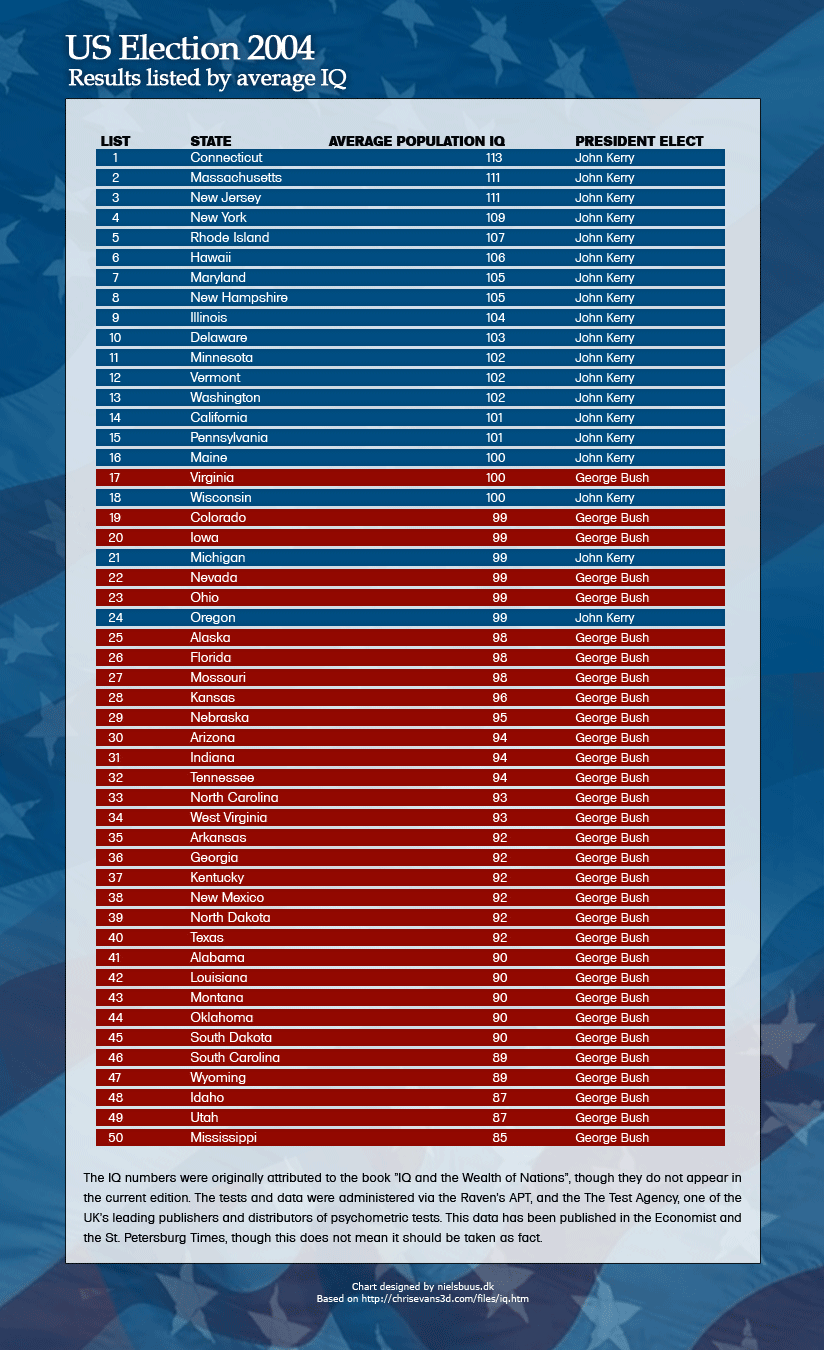
I came across this interesting chart just today which tabulates the average IQ of the states that voted for either Bush or Kerry in the 2004 election. The results are rather telling as seen below:

Click for a larger view.
As seen from this chart here, states with lower IQs favored Bush while states with higher IQs favored Kerry. To put it bluntly, a good democracy only works when the general public is well educated... else you get what have you now in the US.
Click for a larger view.
As seen from this chart here, states with lower IQs favored Bush while states with higher IQs favored Kerry. To put it bluntly, a good democracy only works when the general public is well educated... else you get what have you now in the US.
Saturday, August 11, 2007
Been busy...
Been busy and a little out of it. After handing in my thesis and taking some time off to pursue other projects, I have obviously left this blog in neglect. I have had some interesting ideas in the past and I am currently working on them.
FYI, my predictions of a US stock market slump are on the ball and have resulted in a drop in the stock market in all sectors. I would have never believed that I would be on the ball on this one... the only problem was that I didn't have the guts to make the right moves before all of this tumbling occurred, but I will have to learn to trust myself a little more.
In other news, the Sy's have come to Japan and I had the honor of hosting them for a few days in Sendai and then traveling with them to Aomori to attend to the Nebuta festival. Pictures and details are to follow later on.
Finally, I have been doing some reading on the net and came across this quote which I found interesting:
"Why, of course, the people don't want war, why would some poor slob on a farm want to risk his life in a war when the best that he can get out of it is to come back to his farm in one piece. Naturally, the common people don't want war; neither in Russia nor in England nor in America, nor for that matter in Germany. That is understood. But, after all, it is the leaders of the country who determine the policy and it is always a simple matter to drag the people along, whether it is a democracy or a fascist dictatorship or a Parliament or a Communist dictatorship."
"There is one difference," I pointed out. "In a democracy the people have some say in the matter through their elected representatives, and in the United States only Congress can declare wars." "Oh, that is all well and good, but, voice or no voice, the people can always be brought to the bidding of the leaders. That is easy. All you have to do is tell them they are being attacked and denounce the pacifists for lack of patriotism and exposing the country to danger. It works the same way in any country." --Herman Georing,
For those not in the know, Herman Goering was a military leader and a politician in the Nazi Party. The interview was taken during the trials at Nuremberg after being captured. He brings up a very good point on how countries are dragged into conflicts by their leaders. In the case of the US, we see that history repeats itself with rhetoric that "you're with us or against us" mentality.
Why would a person want to risk their life to join an army? You're risking your life to fight someone else's battle. If you're going to pick a fight, fight it yourself. Only cowards send goons to fight in their place. If a politician chooses to go to war, they should have the obligation to serve on the front lines, perhaps only then might they act responsibly.
FYI, my predictions of a US stock market slump are on the ball and have resulted in a drop in the stock market in all sectors. I would have never believed that I would be on the ball on this one... the only problem was that I didn't have the guts to make the right moves before all of this tumbling occurred, but I will have to learn to trust myself a little more.
In other news, the Sy's have come to Japan and I had the honor of hosting them for a few days in Sendai and then traveling with them to Aomori to attend to the Nebuta festival. Pictures and details are to follow later on.
Finally, I have been doing some reading on the net and came across this quote which I found interesting:
"Why, of course, the people don't want war, why would some poor slob on a farm want to risk his life in a war when the best that he can get out of it is to come back to his farm in one piece. Naturally, the common people don't want war; neither in Russia nor in England nor in America, nor for that matter in Germany. That is understood. But, after all, it is the leaders of the country who determine the policy and it is always a simple matter to drag the people along, whether it is a democracy or a fascist dictatorship or a Parliament or a Communist dictatorship."
"There is one difference," I pointed out. "In a democracy the people have some say in the matter through their elected representatives, and in the United States only Congress can declare wars." "Oh, that is all well and good, but, voice or no voice, the people can always be brought to the bidding of the leaders. That is easy. All you have to do is tell them they are being attacked and denounce the pacifists for lack of patriotism and exposing the country to danger. It works the same way in any country." --Herman Georing,
For those not in the know, Herman Goering was a military leader and a politician in the Nazi Party. The interview was taken during the trials at Nuremberg after being captured. He brings up a very good point on how countries are dragged into conflicts by their leaders. In the case of the US, we see that history repeats itself with rhetoric that "you're with us or against us" mentality.
Why would a person want to risk their life to join an army? You're risking your life to fight someone else's battle. If you're going to pick a fight, fight it yourself. Only cowards send goons to fight in their place. If a politician chooses to go to war, they should have the obligation to serve on the front lines, perhaps only then might they act responsibly.
Sunday, July 22, 2007
Bringing Web 2.0 to the Government
Governance of Online Communities
Internet communities are a fascinating thing. They are born in all sorts of online environments, whether they be bulletin boards, IRC, newsgroups, virtual worlds and more. All of these communities are self governed. Rules of the medium usually written out by some benevolent person expressing the sentiments of those that frequent the medium, for example how to conduct one's self and treat the medium, whether it be the chat room or some online forum.
The leaders of these communities are not elected, they just are simply recognized and followed by those who see them as fit. You will know who the leaders are in an online community, they are the ones doing the charitable acts of good deeds for the community to help it flourish. They are the ones posting up FAQ lists or selflessly taking the responsibility to manage the community.
We see this everywhere, whether it be in an online virtual world like World of Warcraft with a guild leader and members or even an online photo sharing site like flickr where people share wonderful photos and tips on how to take great shots. We see the same thing even in software where the likes of Linus Trovalds is the undisputed leader of the Linux project, though he was never elected into that position.
You can't declare yourself a leader
As much as many people would like to become a leader, you just can't declare that you are a leader and expect people to follow you. Leadership doesn't work like that. Image a person that waltzes into some community, declaring that he wants to be the new administrator and institute all sorts of "improvements" and that everyone should support him. A scenario like that will usually end up with everyone flaming (which is internet speak for "insulting") him and finally ignoring him. To have someone simply walk in and declare themself a leader is absurd as a random person declaring himself as the King of France. How would you know that this person will do their best for the community? It would be like some politician deciding to run against Linus Trovalds to manage the Linux operating system project. Linus pretty much embodies the Linux project.
Quite the contrary to the above process, determination of leadership is done in exactly the opposite manner-- it is the people that choose to follow you. The most common reasons for people to follow someone's leadership is a combination of vision, ability and altruism that defines the best leaders. I am quite certain that nobody that would want to follow a leader that is visionless, incompetent and selfish. The simple act of trying to declare yourself a leader is already selfish, if not egotistical.
The best leaders of online communities have and always been the people that spent their time helping others and the community at large. If you can think of online games with virtual worlds and clans, the people that are at the top of such an organization are the ones that helps the community the most, whether it be though player training, game play coordination, developing a webpage for the team or whatever. The same can be said for online discussion forums, where the most recognized people are the ones that provide the most insightful discussions and those that do their best to answer or direct people with questions to sources where they can find the answers they seek. You don't have to be elected into some position of power to do acts of good will, every person has the tools to do so. Yet, when in terms of our offline communities, our reality is quite the opposite.
Tyrants and the Governance of Offline Communities
When it comes to leadership in real world communities, things take a very different turn, especially when it comes to governance of largest community of all, the country. I have always found it strange that most politicians are usually well off individuals with the financial capital to run an election campaign to collect votes to become leader and represent a community in a governmental position. Yet they lack evidence in what they have done in the past to the benefit of the community before running for this position.
If you were simply to listen to the advertisements of these people, all that you will hear are the things that they want to do for you; their promises, agendas and vision. Perhaps the only characteristic of a leader these people have is vision. But a person that has vision but lacks ability in only a dreamer, a person with both vision and ability but lacks altruism may end up being a tyrant. And unfortunately, the history of politics has been often dominated by tyrants.
The Openness of Web 2.0: The Collaborative Effort
The defining difference between online communities and real world communities is the openness in which the online communities operate. Projects such as wikipedia operate on this basis where the entire database of encyclopedic information is open to public edits and additions which has allowed the online encyclopedia to flourish and be one of the first stops on the internet for people wanting to get a good summary of nearly any topic.
It would be impossible for Wikipedia to be as successful as it is today as an encyclopedic source without its open collaborative nature. It was at first proposed that people submit articles to Wikipedia and the contents would be reviewed by designated experts. Wikipedia never did start to take off until it was a fully open system, generally governed by the users that add content to the encyclopedia.
Such an open system is, of course, open to abuse. But the beauty of such a self-governing system is self-correcting, with the users of the wikipedia taking the responsibility to keep the entries as truthful as possible. Wikipedia users have found US politicians editing their own and the profiles of others for politically motivated reasons by tracking the editor IP addresses to government institutions. At first edit wars occurred trying to prevent malicious users from corrupting the entries (these entries usually have to cite sources to be credible). Finally, the Wikipedia community and administrators responded by restricting edits of political entries to more credible members that have contributed to the project over a longer period of time, after much discussion on the message boards. Without this kind of openness such behavior could not be caught, nor could the community be as well organized to come up with a viable solution.
Bringing the Collaborative Effort to Government
Democracy has origins dating back to 500 BC in Greece and possibly earlier to 2500 BC in Mesopotamia. The selection of representatives in a Democratic government was done because it was too impractical to have the general public involved in policy decision. It was more efficient to have a smaller number of people involved to set policies with checks on representatives to prevent abuse of executive powers for personal gain. Instead of having everyone vote on every issue, you now have a smaller number of representatives voting on issues for the people they represent. Interestingly, this is the same collaborative efforts that Web 2.0 strives to attain in a more primitive form.
But now with the internet and our ability to quickly communicate, the limitations of a traditional democratic government by elected representatives can now be alleviated. Instead of representatives acting on our behalf, the general public can now be involved in a collaborative effort to set policies and enact laws. The expertise of everyone can be leveraged in a wider variety of fields, compared to the limited knowledge base of a single politician. For example, public domain government funding and statistical data could be quickly analyzed and leveraged by experts through prudent open review with important discussions held in online forums. The discussions can also be referenced back to in the future. Finally, a policy can be set and a person or an organization can be selected to carry out the task.
Having everyone active in every aspect of government management is not necessary as seen in the Wikipedia example. Participation should be optional. We will find that altruistic people with sufficient knowledge and expertise will be the ones making the best decisions for the public at large. Decision making related information and analysis can all be posted online and referenced, giving people a far better understanding of a whole issue. Should a person have an interest in a specific bill, they have the option of voting on it, else abstaining from the vote, as voting on every bill would be very tedious.
A web 2.0 style of collaborative government management by the general public would be beneficial in increasing government efficiency, transparency, and accountability. Most importantly of all, the system is even more democratic by allowing everyone direct input into the governing process.
Of course, by allowing everyone to participate in the governing process, the amount of white noise ideas from the sheer number of people involved could be cumbersome, however, techniques of filtering white noise from good ideas/information is already well developed as seen on the internet. Google as one example being able to sift through billions of webpages to return relevant search results in a fraction of a second and information aggregate sites such as Digg and Reddit, where submitted links are ranked by users voting up or down on these links. The most interesting links will generally filter up to the top of the list.
With the current state of technology as it is now, implementing a form of government like this is a very feasible concept. I do believe that this concept could mark a new era of governance, the concept of a collaborative government.
Internet communities are a fascinating thing. They are born in all sorts of online environments, whether they be bulletin boards, IRC, newsgroups, virtual worlds and more. All of these communities are self governed. Rules of the medium usually written out by some benevolent person expressing the sentiments of those that frequent the medium, for example how to conduct one's self and treat the medium, whether it be the chat room or some online forum.
The leaders of these communities are not elected, they just are simply recognized and followed by those who see them as fit. You will know who the leaders are in an online community, they are the ones doing the charitable acts of good deeds for the community to help it flourish. They are the ones posting up FAQ lists or selflessly taking the responsibility to manage the community.
We see this everywhere, whether it be in an online virtual world like World of Warcraft with a guild leader and members or even an online photo sharing site like flickr where people share wonderful photos and tips on how to take great shots. We see the same thing even in software where the likes of Linus Trovalds is the undisputed leader of the Linux project, though he was never elected into that position.
You can't declare yourself a leader
As much as many people would like to become a leader, you just can't declare that you are a leader and expect people to follow you. Leadership doesn't work like that. Image a person that waltzes into some community, declaring that he wants to be the new administrator and institute all sorts of "improvements" and that everyone should support him. A scenario like that will usually end up with everyone flaming (which is internet speak for "insulting") him and finally ignoring him. To have someone simply walk in and declare themself a leader is absurd as a random person declaring himself as the King of France. How would you know that this person will do their best for the community? It would be like some politician deciding to run against Linus Trovalds to manage the Linux operating system project. Linus pretty much embodies the Linux project.
Quite the contrary to the above process, determination of leadership is done in exactly the opposite manner-- it is the people that choose to follow you. The most common reasons for people to follow someone's leadership is a combination of vision, ability and altruism that defines the best leaders. I am quite certain that nobody that would want to follow a leader that is visionless, incompetent and selfish. The simple act of trying to declare yourself a leader is already selfish, if not egotistical.
The best leaders of online communities have and always been the people that spent their time helping others and the community at large. If you can think of online games with virtual worlds and clans, the people that are at the top of such an organization are the ones that helps the community the most, whether it be though player training, game play coordination, developing a webpage for the team or whatever. The same can be said for online discussion forums, where the most recognized people are the ones that provide the most insightful discussions and those that do their best to answer or direct people with questions to sources where they can find the answers they seek. You don't have to be elected into some position of power to do acts of good will, every person has the tools to do so. Yet, when in terms of our offline communities, our reality is quite the opposite.
Tyrants and the Governance of Offline Communities
When it comes to leadership in real world communities, things take a very different turn, especially when it comes to governance of largest community of all, the country. I have always found it strange that most politicians are usually well off individuals with the financial capital to run an election campaign to collect votes to become leader and represent a community in a governmental position. Yet they lack evidence in what they have done in the past to the benefit of the community before running for this position.
If you were simply to listen to the advertisements of these people, all that you will hear are the things that they want to do for you; their promises, agendas and vision. Perhaps the only characteristic of a leader these people have is vision. But a person that has vision but lacks ability in only a dreamer, a person with both vision and ability but lacks altruism may end up being a tyrant. And unfortunately, the history of politics has been often dominated by tyrants.
The Openness of Web 2.0: The Collaborative Effort
The defining difference between online communities and real world communities is the openness in which the online communities operate. Projects such as wikipedia operate on this basis where the entire database of encyclopedic information is open to public edits and additions which has allowed the online encyclopedia to flourish and be one of the first stops on the internet for people wanting to get a good summary of nearly any topic.
It would be impossible for Wikipedia to be as successful as it is today as an encyclopedic source without its open collaborative nature. It was at first proposed that people submit articles to Wikipedia and the contents would be reviewed by designated experts. Wikipedia never did start to take off until it was a fully open system, generally governed by the users that add content to the encyclopedia.
Such an open system is, of course, open to abuse. But the beauty of such a self-governing system is self-correcting, with the users of the wikipedia taking the responsibility to keep the entries as truthful as possible. Wikipedia users have found US politicians editing their own and the profiles of others for politically motivated reasons by tracking the editor IP addresses to government institutions. At first edit wars occurred trying to prevent malicious users from corrupting the entries (these entries usually have to cite sources to be credible). Finally, the Wikipedia community and administrators responded by restricting edits of political entries to more credible members that have contributed to the project over a longer period of time, after much discussion on the message boards. Without this kind of openness such behavior could not be caught, nor could the community be as well organized to come up with a viable solution.
Bringing the Collaborative Effort to Government
Democracy has origins dating back to 500 BC in Greece and possibly earlier to 2500 BC in Mesopotamia. The selection of representatives in a Democratic government was done because it was too impractical to have the general public involved in policy decision. It was more efficient to have a smaller number of people involved to set policies with checks on representatives to prevent abuse of executive powers for personal gain. Instead of having everyone vote on every issue, you now have a smaller number of representatives voting on issues for the people they represent. Interestingly, this is the same collaborative efforts that Web 2.0 strives to attain in a more primitive form.
But now with the internet and our ability to quickly communicate, the limitations of a traditional democratic government by elected representatives can now be alleviated. Instead of representatives acting on our behalf, the general public can now be involved in a collaborative effort to set policies and enact laws. The expertise of everyone can be leveraged in a wider variety of fields, compared to the limited knowledge base of a single politician. For example, public domain government funding and statistical data could be quickly analyzed and leveraged by experts through prudent open review with important discussions held in online forums. The discussions can also be referenced back to in the future. Finally, a policy can be set and a person or an organization can be selected to carry out the task.
Having everyone active in every aspect of government management is not necessary as seen in the Wikipedia example. Participation should be optional. We will find that altruistic people with sufficient knowledge and expertise will be the ones making the best decisions for the public at large. Decision making related information and analysis can all be posted online and referenced, giving people a far better understanding of a whole issue. Should a person have an interest in a specific bill, they have the option of voting on it, else abstaining from the vote, as voting on every bill would be very tedious.
A web 2.0 style of collaborative government management by the general public would be beneficial in increasing government efficiency, transparency, and accountability. Most importantly of all, the system is even more democratic by allowing everyone direct input into the governing process.
Of course, by allowing everyone to participate in the governing process, the amount of white noise ideas from the sheer number of people involved could be cumbersome, however, techniques of filtering white noise from good ideas/information is already well developed as seen on the internet. Google as one example being able to sift through billions of webpages to return relevant search results in a fraction of a second and information aggregate sites such as Digg and Reddit, where submitted links are ranked by users voting up or down on these links. The most interesting links will generally filter up to the top of the list.
With the current state of technology as it is now, implementing a form of government like this is a very feasible concept. I do believe that this concept could mark a new era of governance, the concept of a collaborative government.
Friday, July 20, 2007
Currency matters for trading
It is no secret that the US dollar has been in decline for the past 5 years. Today, I decided to take a further look at this against the CAD, Euro and the Japanese Yen and came up with this plot using UBC's Sauder School of Business's pacific exchange rate service.

The Canadian dollar and the Euro is currently up 50% as discussed in a previous post. The Japanese yen, not doing as well, is up 10% over the last 5 years. Now considering the following case, suppose that you were a US resident investing in Canada or Europe with a 10% yearly return on those investments. The return on those investments would yield a 61% portfolio increase. Now, if one were to add in the currency effects in to the equation, a 140% portfolio increase would result. The net returns from a portfolio also taking advantage of long term currency changes can double the capital gains made on an investment.
As a result of this, it is not just important to know how well the company is doing, but one should also take into account how well the currency will do in the future when making investment decisions.

The Canadian dollar and the Euro is currently up 50% as discussed in a previous post. The Japanese yen, not doing as well, is up 10% over the last 5 years. Now considering the following case, suppose that you were a US resident investing in Canada or Europe with a 10% yearly return on those investments. The return on those investments would yield a 61% portfolio increase. Now, if one were to add in the currency effects in to the equation, a 140% portfolio increase would result. The net returns from a portfolio also taking advantage of long term currency changes can double the capital gains made on an investment.
As a result of this, it is not just important to know how well the company is doing, but one should also take into account how well the currency will do in the future when making investment decisions.
Wednesday, July 18, 2007
July 24th 2007
My final defense will he held this coming Tuesday and I will be making my presentation to 4 professors, 2 of which are from my lab and 2 others in the Nanomecanics department. My presentation is largely done weighing at 40 some odd slides. I will be trimming this presentation down to 20 minutes and to allow 10 minutes for questioning. I find it rather interesting that I will be summarizing 2 years of work into 20 minutes.
After that, I will be waiting for a response from the conference organizers that will be hosting a conference in Denmark. If things go well, I will he hoping to attend a nanotechnology conference somewhere in September for about 4~5 day in Demnark and perhaps do some traveling around Europe if I can swing that.
This will be a busy next few months, but I will be looking forward to it.
After that, I will be waiting for a response from the conference organizers that will be hosting a conference in Denmark. If things go well, I will he hoping to attend a nanotechnology conference somewhere in September for about 4~5 day in Demnark and perhaps do some traveling around Europe if I can swing that.
This will be a busy next few months, but I will be looking forward to it.
Thursday, July 12, 2007
The US Economy in Trouble
There has been lots of news recently in terms of the health of the US economy. The news is looking grim in terms of many indicators.
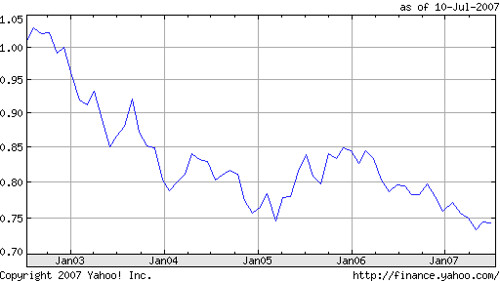
The US dollar has lost over 25% of it's value over the the last 5 years compared with the Euro as seen in the chart below.

The number of Euros 1 USD can buy
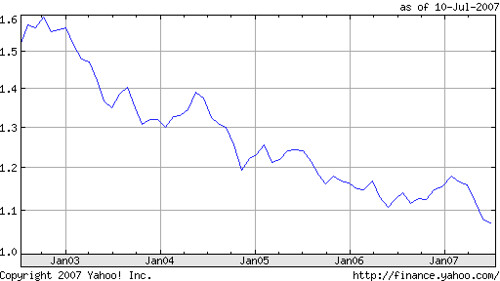
The same is also happening against the Canadian dollar as seen in the next chart.

The number of Canadian dollars 1USD can buy
We see here, that over the last 5 years, the US dollar has lost close to 40 cents in value from $1.5 CAD to $1.1 CAD which also represents a 25% drop in the American currency.
Why is this happening? A lesson in inflation
This is the result of the US government going into further debt with the funding of the Iraq war and the currently worsening economy.
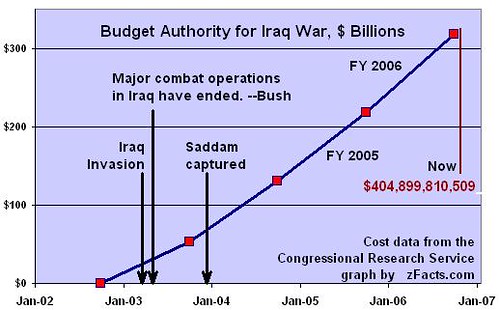
In terms of the Iraq war, the US government, to-date, has spent approximately $400 billion USD to since it's beginning in 2002. The money obviously had to come from somewhere and it is not likely that the US government kept a stock pile of cash to pay for the war since they were already in debt at that time. What the US government had to do is to take loans from other countries to finance this war.

The graph above here is the total amount of money spent on the war as time goes on.
How this war is financed is through the US taking loans from other countries in the form of treasury bonds which are promissory notes that the US government will repay those countries with US currency after a certain number of years with interest. Foreign countries buy these bonds using their currency to purchase them in USD. For example, a US treasury bond could go for $100,000 and the US government would put a guarantee that the US will pay interest on the money borrowed for as long as the money is borrowed until is it paid off. The rate is in the ballpark of 2% every 3 months.
The value of a currency is also set against the loans of a country makes against others. The value of a currency against others is controlled through inflation. Inflation is traditionally thought as the rate of increase of money in circulation which cases the price of goods and services to increase. For example, if everyone had $100 in their pocket one year and because the US prints more money every year and distributes it, everyone might have on average $103 in their pockets the next year. As a result, merchants know they can increase their price to get people to pay more for their good and services because of the availability of money in circulation.
It's like saying that in America, everyone carries $100 in their pockets and buys a drink for $1 and in Mexico everyone carries 1000 pesos and buys a drink for 10 pesos. Costs are relative in relation to the amount of money in circulation. In other words, printing more money means that the currency is devalued, making it less valuable. This makes sense because the more rare something is, the more valuable it is. This is actually why gold was used as a standard for currency long ago and money was actually backed by gold. It isn't anymore and unbacked money is called fiat currency. I could go into a separate conversation about fiat money but it will end up as a lengthy conversation which I have no plans on covering at this time (if you are interested, you are welcome to read up on it on your own).
One way that the US government pays for things is through printing money, which the government uses to pay for goods and services. The government actually makes money come out of thin air and pays for things with it. This is what is often called the "invisible tax" because the money which people have is devalued to let the government pay for things by printing money and increasing the money in circulation. This is the heart of the concept of inflation. In actual fact, the government doesn't actually print it's money, but a government/private controlled bank called the Federal Reserve prints the money and the US government takes loans from this bank to pay for things. But despite this, the fundamentals remain the same.
The effects of inflation and debt on currency valuation (and international trade)
Now this concept becomes very fascinating when it comes to international trade and financing. In order to finance the Iraq war, for example, the US requires resources to wage it's war. It simply just can't print money and distribute it to within the US and expect more resources to come out of thin air-- though money can be created from thin air, resources on the other hand cannot be pulled out of thin air. The US must also trade with other countries to get the resources it requires.
There are two ways which the US can pay for things from another country, the first is through cash payments, which the US must print and distribute to these countries. The problem with this method is that the US must print exorbitant amounts of money to send to these countries which will thus increase the amount of US money circulating in the world and immediately result in the devaluation of US currency.
This is obviously undesirable because you have an effect of diminishing returns. For example, the first time you have to pay $1 billion to get 500,000 barrels of oil. The second time around, you need to pay $1.3 billion to get 500,000 barrels of oil, every time that money needs to be created to buy things, the currency is devalued. This becomes a problem for everyone in the US, especially for international businesses. When the currency becomes devalued, it becomes harder for companies in the US to import things or pay for foreign labor.
For example, if the salary of a Chinese worker was 76,000 yuan a year which costs a US company $10,000 USD to fund. Through currency devaluation, US companies may have to pay $12,000 in salary the next year and then $13,000 a year to fund the same 76,000 Chinese yuan a year of that worker to make goods for import into the US market. Currency devaluation has very serious impacts on international trade. Just to let you know, Apple manufactures its iPods in China and could face rising costs because of the devaluing US dollar. If the US dollar declines too much, Apple may have to increase the costs of an iPod because the US dollar is worth less to pay for things abroad.
Instead of doing this, a second method is used to more gradually increase the amount of US money in circulation which comes in the form of US treasury bonds as loans as mentioned earlier. US treasury bonds are far less liquid (not easily exchangeable) and pay an amount of interest in every period of time (ie. every 3 months, every year etc) . Since treasury bonds is not real cash and because it pays interest gradually, devaluation of the US currency is thus gradual until it has to return the money at the end of the loan term. If the economy is good, the US government will probably have the money in the end and can pay off it's loans without trouble, if it doesn't, the government needs to print the money, resulting in USD devaluation.
Measuring economic health and a country's ability to pay off debt
The alternative to printing money and devaluing the US currency is to produce goods and services that foreign countries want to buy from the US to offset these costs. To explain this, suppose that you have many successful companies in the US making many useful products and exporting them to countries around the world. These companies make money from international trade which is then taxed and becomes money that the US government can use to run programs and/or pay off it's debt. The more successful the US companies are, the more income the government can make and the easier it is for the government to pay off the debt.
So, then, let's take a look at the trade balance of the US in international trade which I have taken from wikipedia and is posted below for reference.

The US trade deficit since 1991
By looking at this chart, we can observe that for the past 14 years that the US trade deficit has been increasing yearly and becoming more and more negative. What this means is that the US is borrowing or paying out more and more money yearly because it imports more than it exports.
I see two possible causes for this problem. The first possible cause is that US per capita consumes far too much and it driving itself into debt from over consumption. The second reason is a result of economic weakness of the US in the international market leading to exports not keeping up with imports. I believe that the US faces a combination of both problems due to outsourcing of work and manufacturing and massive imports from other countries like China. What this means is that the US is getting goods from imports while not producing enough exports to keep a fair balance in trade.
The current US economic future is DOOMED
Based on increasing governmental debt and the growing trade deficit, the US economy will continually get worse. The US debt and the trade deficit is increasing yearly, meaning that the US currency will be further devalued. As many US companies have outsourced or import goods from abroad, the outsourced work and goods will become more expensive, thus diminishing the profits of US based companies. Imported goods will be less affordable in the future, reducing the purchasing power of the ordinary citizen... whom are already in debt with high loans and interest rates.
The prospects for the US economy are grim and I would advise against making long term investments in the US due to weakening economic conditions. The currency will continually drop as the economy weakens. An economic crash may occur in the US which may bring down the currency further. Investing in the US might become good after this crash when the economy has stabilized and the currency is cheap enough for international companies to consider investing in the US.
Though this is speculative, I believe that poor foreign and local economic policies have led to increased governmental debt and the weakening of the US economy. The problem is largely due to the government spending too much on the Iraq war and then requesting that US citizens spend more (as in take on more debt) to finance the government debt through taxes. I do not believe that the US economy will be able to support the debt in the future, unless changes are made. The US government has made poor financial decisions and despite it's poor approval rating of 29%, the general population has done a poor job of holding the government accountable.
As a result of these findings, I believe that exposure to US currency should be reduced (ie. if you have US money, sell it off). Warren Buffet has also made a similar play a few years ago by selling his US money against other currency in 2002. I also advise against investing money in the US index funds which are measuring the metrics of the US economy and would invest outside of the US.
It is unfortunate that the future of the US economy looks like this and the impact it will have on it's citizens, but until attitudes change, nothing much can be done to change the current state of things.
The US dollar has lost over 25% of it's value over the the last 5 years compared with the Euro as seen in the chart below.
The number of Euros 1 USD can buy
The same is also happening against the Canadian dollar as seen in the next chart.
The number of Canadian dollars 1USD can buy
We see here, that over the last 5 years, the US dollar has lost close to 40 cents in value from $1.5 CAD to $1.1 CAD which also represents a 25% drop in the American currency.
Why is this happening? A lesson in inflation
This is the result of the US government going into further debt with the funding of the Iraq war and the currently worsening economy.
In terms of the Iraq war, the US government, to-date, has spent approximately $400 billion USD to since it's beginning in 2002. The money obviously had to come from somewhere and it is not likely that the US government kept a stock pile of cash to pay for the war since they were already in debt at that time. What the US government had to do is to take loans from other countries to finance this war.
The graph above here is the total amount of money spent on the war as time goes on.
How this war is financed is through the US taking loans from other countries in the form of treasury bonds which are promissory notes that the US government will repay those countries with US currency after a certain number of years with interest. Foreign countries buy these bonds using their currency to purchase them in USD. For example, a US treasury bond could go for $100,000 and the US government would put a guarantee that the US will pay interest on the money borrowed for as long as the money is borrowed until is it paid off. The rate is in the ballpark of 2% every 3 months.
The value of a currency is also set against the loans of a country makes against others. The value of a currency against others is controlled through inflation. Inflation is traditionally thought as the rate of increase of money in circulation which cases the price of goods and services to increase. For example, if everyone had $100 in their pocket one year and because the US prints more money every year and distributes it, everyone might have on average $103 in their pockets the next year. As a result, merchants know they can increase their price to get people to pay more for their good and services because of the availability of money in circulation.
It's like saying that in America, everyone carries $100 in their pockets and buys a drink for $1 and in Mexico everyone carries 1000 pesos and buys a drink for 10 pesos. Costs are relative in relation to the amount of money in circulation. In other words, printing more money means that the currency is devalued, making it less valuable. This makes sense because the more rare something is, the more valuable it is. This is actually why gold was used as a standard for currency long ago and money was actually backed by gold. It isn't anymore and unbacked money is called fiat currency. I could go into a separate conversation about fiat money but it will end up as a lengthy conversation which I have no plans on covering at this time (if you are interested, you are welcome to read up on it on your own).
One way that the US government pays for things is through printing money, which the government uses to pay for goods and services. The government actually makes money come out of thin air and pays for things with it. This is what is often called the "invisible tax" because the money which people have is devalued to let the government pay for things by printing money and increasing the money in circulation. This is the heart of the concept of inflation. In actual fact, the government doesn't actually print it's money, but a government/private controlled bank called the Federal Reserve prints the money and the US government takes loans from this bank to pay for things. But despite this, the fundamentals remain the same.
The effects of inflation and debt on currency valuation (and international trade)
Now this concept becomes very fascinating when it comes to international trade and financing. In order to finance the Iraq war, for example, the US requires resources to wage it's war. It simply just can't print money and distribute it to within the US and expect more resources to come out of thin air-- though money can be created from thin air, resources on the other hand cannot be pulled out of thin air. The US must also trade with other countries to get the resources it requires.
There are two ways which the US can pay for things from another country, the first is through cash payments, which the US must print and distribute to these countries. The problem with this method is that the US must print exorbitant amounts of money to send to these countries which will thus increase the amount of US money circulating in the world and immediately result in the devaluation of US currency.
This is obviously undesirable because you have an effect of diminishing returns. For example, the first time you have to pay $1 billion to get 500,000 barrels of oil. The second time around, you need to pay $1.3 billion to get 500,000 barrels of oil, every time that money needs to be created to buy things, the currency is devalued. This becomes a problem for everyone in the US, especially for international businesses. When the currency becomes devalued, it becomes harder for companies in the US to import things or pay for foreign labor.
For example, if the salary of a Chinese worker was 76,000 yuan a year which costs a US company $10,000 USD to fund. Through currency devaluation, US companies may have to pay $12,000 in salary the next year and then $13,000 a year to fund the same 76,000 Chinese yuan a year of that worker to make goods for import into the US market. Currency devaluation has very serious impacts on international trade. Just to let you know, Apple manufactures its iPods in China and could face rising costs because of the devaluing US dollar. If the US dollar declines too much, Apple may have to increase the costs of an iPod because the US dollar is worth less to pay for things abroad.
Instead of doing this, a second method is used to more gradually increase the amount of US money in circulation which comes in the form of US treasury bonds as loans as mentioned earlier. US treasury bonds are far less liquid (not easily exchangeable) and pay an amount of interest in every period of time (ie. every 3 months, every year etc) . Since treasury bonds is not real cash and because it pays interest gradually, devaluation of the US currency is thus gradual until it has to return the money at the end of the loan term. If the economy is good, the US government will probably have the money in the end and can pay off it's loans without trouble, if it doesn't, the government needs to print the money, resulting in USD devaluation.
Measuring economic health and a country's ability to pay off debt
The alternative to printing money and devaluing the US currency is to produce goods and services that foreign countries want to buy from the US to offset these costs. To explain this, suppose that you have many successful companies in the US making many useful products and exporting them to countries around the world. These companies make money from international trade which is then taxed and becomes money that the US government can use to run programs and/or pay off it's debt. The more successful the US companies are, the more income the government can make and the easier it is for the government to pay off the debt.
So, then, let's take a look at the trade balance of the US in international trade which I have taken from wikipedia and is posted below for reference.

The US trade deficit since 1991
By looking at this chart, we can observe that for the past 14 years that the US trade deficit has been increasing yearly and becoming more and more negative. What this means is that the US is borrowing or paying out more and more money yearly because it imports more than it exports.
I see two possible causes for this problem. The first possible cause is that US per capita consumes far too much and it driving itself into debt from over consumption. The second reason is a result of economic weakness of the US in the international market leading to exports not keeping up with imports. I believe that the US faces a combination of both problems due to outsourcing of work and manufacturing and massive imports from other countries like China. What this means is that the US is getting goods from imports while not producing enough exports to keep a fair balance in trade.
The current US economic future is DOOMED
Based on increasing governmental debt and the growing trade deficit, the US economy will continually get worse. The US debt and the trade deficit is increasing yearly, meaning that the US currency will be further devalued. As many US companies have outsourced or import goods from abroad, the outsourced work and goods will become more expensive, thus diminishing the profits of US based companies. Imported goods will be less affordable in the future, reducing the purchasing power of the ordinary citizen... whom are already in debt with high loans and interest rates.
The prospects for the US economy are grim and I would advise against making long term investments in the US due to weakening economic conditions. The currency will continually drop as the economy weakens. An economic crash may occur in the US which may bring down the currency further. Investing in the US might become good after this crash when the economy has stabilized and the currency is cheap enough for international companies to consider investing in the US.
Though this is speculative, I believe that poor foreign and local economic policies have led to increased governmental debt and the weakening of the US economy. The problem is largely due to the government spending too much on the Iraq war and then requesting that US citizens spend more (as in take on more debt) to finance the government debt through taxes. I do not believe that the US economy will be able to support the debt in the future, unless changes are made. The US government has made poor financial decisions and despite it's poor approval rating of 29%, the general population has done a poor job of holding the government accountable.
As a result of these findings, I believe that exposure to US currency should be reduced (ie. if you have US money, sell it off). Warren Buffet has also made a similar play a few years ago by selling his US money against other currency in 2002. I also advise against investing money in the US index funds which are measuring the metrics of the US economy and would invest outside of the US.
It is unfortunate that the future of the US economy looks like this and the impact it will have on it's citizens, but until attitudes change, nothing much can be done to change the current state of things.
Friday, July 06, 2007
How you can save $100,000 on a Mortgage
I have been doing some reading about the current problems with real estate in the US. According to many news articles I have been reading recently, there seems to be a lot of problems with people defaulting on their mortgage loans. As a result of this, there are more houses being put back into the housing market and analysts are currently worried about a housing bust. As a result of the news I have been reading, I wanted to see what does it take to successfully pay off a home mortgage.
Unfortunately, there are many people out there that have not done any financial calculations on how to pay down a mortgage and often have to rely on bankers to do the calculations for them. You are literally asking the fox to guard the hen house when you put yourself in that situation. It is the objective of the bank to get as much money out of you possible. Most people allow the bank to do exactly that by giving the bank your personal income details which allows them to come up with a payment plan for you which maximizes their profits. It is imperative that you do these calculations on your own before going to the bank to know what exactly you are getting into.
I have done some calculations today to get a general understanding of what a mortgage payment plan looks like and how much money will it take to pay it down in the long run. The results are startling because I have found that a $200 difference in your monthly payment can make a a $100,000 difference on the total amount of money spent paying down the mortgage. Yes, the results I present here can save you over $100,000!
The mortgage calculations have been done in an Excel Spreadsheet and I have made the following assumptions:
Home/Apartment Cost = $250,000
Down Payment = $75,000
Interest Rate = %7.5
Monthly Payment = $1,200~$1,400
Using these values, the initial outstanding mortgage balance is $175,000 and I have done the calculations to determine how much money and how long will it take for you to pay off the loan. I have plotted the results for monthly payments of $1,200, $1,300 and $1,400 and the results mortgage balance vs year plot is shown below.

The graph appears a little blurry but if you click on it, a better resolution version will come up.
The total amount of money paid yearly until the mortgage is paid of was then summed up for each different payment rate and the results are summarized in the table below.

The result of this calculation is very revealing. The $1,400 payment obviously allows a person to pay off the $175,000 loan the fastest at 21 years. By just decreasing the monthly payment by $100, it takes an additional 4 years, by reducing the monthly payment by $100 further, the time to pay off the loan takes an additional 13 years!
The difference between the total amount of money paid also varies greatly with the monthly payment rate. The calculations show that the total payment increases by $45,000 when you pay $1,300/month compared to $1,400/month. The difference becomes staggering when the payment rate drops by only $200 to $1,200/month with a difference of over $130,000. The banks would be more than happy for you to pay $1,200/month and extract more money out of you. A $130,000 difference is very serious money!
The result presented here is particular to this example and used as a reference only to this example. For other cases, I highly recommend that you perform your own calculations to know exactly what to expect at the end. Based on this result, I would be more than happy to save an additional $3/day to for nearly $100/month to save myself $45,000 in the long run. Save more daily and you will save more than $130,000 in this case. The results I present here are very profound and will definitely help you when it comes to saving significant amounts of money.
I should note that also if you borrow more money you also must expect to pay more monthly to have the debt paid off to reduce the amount of interest paid.
Unfortunately, there are many people out there that have not done any financial calculations on how to pay down a mortgage and often have to rely on bankers to do the calculations for them. You are literally asking the fox to guard the hen house when you put yourself in that situation. It is the objective of the bank to get as much money out of you possible. Most people allow the bank to do exactly that by giving the bank your personal income details which allows them to come up with a payment plan for you which maximizes their profits. It is imperative that you do these calculations on your own before going to the bank to know what exactly you are getting into.
I have done some calculations today to get a general understanding of what a mortgage payment plan looks like and how much money will it take to pay it down in the long run. The results are startling because I have found that a $200 difference in your monthly payment can make a a $100,000 difference on the total amount of money spent paying down the mortgage. Yes, the results I present here can save you over $100,000!
The mortgage calculations have been done in an Excel Spreadsheet and I have made the following assumptions:
Home/Apartment Cost = $250,000
Down Payment = $75,000
Interest Rate = %7.5
Monthly Payment = $1,200~$1,400
Using these values, the initial outstanding mortgage balance is $175,000 and I have done the calculations to determine how much money and how long will it take for you to pay off the loan. I have plotted the results for monthly payments of $1,200, $1,300 and $1,400 and the results mortgage balance vs year plot is shown below.

The graph appears a little blurry but if you click on it, a better resolution version will come up.
The total amount of money paid yearly until the mortgage is paid of was then summed up for each different payment rate and the results are summarized in the table below.

The result of this calculation is very revealing. The $1,400 payment obviously allows a person to pay off the $175,000 loan the fastest at 21 years. By just decreasing the monthly payment by $100, it takes an additional 4 years, by reducing the monthly payment by $100 further, the time to pay off the loan takes an additional 13 years!
The difference between the total amount of money paid also varies greatly with the monthly payment rate. The calculations show that the total payment increases by $45,000 when you pay $1,300/month compared to $1,400/month. The difference becomes staggering when the payment rate drops by only $200 to $1,200/month with a difference of over $130,000. The banks would be more than happy for you to pay $1,200/month and extract more money out of you. A $130,000 difference is very serious money!
The result presented here is particular to this example and used as a reference only to this example. For other cases, I highly recommend that you perform your own calculations to know exactly what to expect at the end. Based on this result, I would be more than happy to save an additional $3/day to for nearly $100/month to save myself $45,000 in the long run. Save more daily and you will save more than $130,000 in this case. The results I present here are very profound and will definitely help you when it comes to saving significant amounts of money.
I should note that also if you borrow more money you also must expect to pay more monthly to have the debt paid off to reduce the amount of interest paid.
Monday, June 25, 2007
Thesis home stretch
As of this moment, I have over 10,000 words written for my thesis and over 60 pages in material at 1.5 line spacing. I haven't been very liberal with spacing as of yet but the goal will be to hit 70-80 pages for the thesis once I am complete. I have inserted a lot of points that I haven't referenced yet and I still need to insert more figures and then to a check of the whole thing after finishing up. The thesis is due in 3 weeks and if everything goes well, I will have this thing done about a week in advance. I would have never imagined myself being on the ball for the thesis writing but this is most relaxed end stretch I've ever had for a large project, especially for one that I've been working on over the span of 2 years. Go figure, but I am pretty happy about it.
In other news, last weekend was a party for the lab members after finishing their job hunting efforts. We have all been placed. 3 will be going to Canon, 1 to Hirose-denki (connector manufacturing), 1 to Sony (me) and 1 to Hitachi. Everyone here has been placed into large corporations. We will see how things go from here, but we will have the opportunity to stay in contact as all of us will be based in the Tokyo area. Out of the group, I have the honor of being the first one placed after doing a one-shot application to Sony (no applications to other company), passing all 3 interviews and making it in. My fall back was the University recommendation system that would likely get me placed somewhere.
I spent the next day with a friend checking out a caldera in the mountain in a region called Zao. I'll post pictures later, but it was pretty nice and there was still snow up there, despite it being warm enough for me to walk around in shorts. I spent the afternoon in a hot spring and then headed home.
I still have much to do with my thesis and will look forward to getting it done. Then I will try and have this research published in a journal somewhere. First things first, finish the thesis and defend.
In other news, last weekend was a party for the lab members after finishing their job hunting efforts. We have all been placed. 3 will be going to Canon, 1 to Hirose-denki (connector manufacturing), 1 to Sony (me) and 1 to Hitachi. Everyone here has been placed into large corporations. We will see how things go from here, but we will have the opportunity to stay in contact as all of us will be based in the Tokyo area. Out of the group, I have the honor of being the first one placed after doing a one-shot application to Sony (no applications to other company), passing all 3 interviews and making it in. My fall back was the University recommendation system that would likely get me placed somewhere.
I spent the next day with a friend checking out a caldera in the mountain in a region called Zao. I'll post pictures later, but it was pretty nice and there was still snow up there, despite it being warm enough for me to walk around in shorts. I spent the afternoon in a hot spring and then headed home.
I still have much to do with my thesis and will look forward to getting it done. Then I will try and have this research published in a journal somewhere. First things first, finish the thesis and defend.
Monday, June 18, 2007
Grilled Apple
I hit the Apple store this weekend while waiting to meet up with a friend (as this friend of mine has chronic punctuality issues), so there I was looking at some MacBooks contemplating if I should ever get one. To summarize the story, I grilled 3 store clerks and was totally unconvinced about buying an Apple computer and left the store with them apologizing to me (well this is Japan) that they couldn't give me any real reasons to switch.
Now, let me tell you how did I come to that conclusion. While I was fiddling around with a MacBook, one of the store clerks came by and asked me if I had any questions, so I decided to chat it up with him to find out if there were any good reasons for me to switch over to an Apple computer.
Reason #1: You don't get viruses or spyware.
No, I am absolutely not buying an Apple computer just because it will protect me from viruses or spyware. I am already an experienced PC user that can handle my own against computer problems. This is seriously a weak reason to me because when I want to buy new hardware, I want a technical advantage.
Reason #2: Nice software that lets me do things.
The sales people basically pitched the photo album software (organization and printing software) to me that looked nice with smooth moving windows. I already have free software like google's Picasa that let's me to pretty much the same thing and I made my case out to them. Then they pointed out other applications like Adobe's Photoshop or Illustrator... which are terrible reasons for me to switch because there are Windows versions of the same software.
To add insult to injury, I asked them if I had a license to run these programs on my PC, would I be able to transfer it over to the Apple computer?
Their answer: nope, you'd need to buy a new copy.
Reason #3: It's got good hardware
They started telling me how they've got the Intel Core Duo 2 chips inside the laptops which are pretty good processors, but you can get them for any other laptops too. I don't buy that reasoning. Anything Apple branded generally costs more than if it were to come from some other laptop manufacturer for the exact/similar hardware configuration.
Reason #4: The OS is nicer
They told me that Mac OS is nicer because I can get to my applications in say 3 clicks instead of 5. Last time I checked, I can usually get to my applications in about 2 on my computer (it's called the toolbar). Then they told me that the OS looks nice.... then I asked them if the OS ran any faster than Windows... to which they didn't have an answer.
So after spending about 45 minutes in the Apple store, the main reason why I should shell out $1400+ for an Apple computer (or say $200 more than a similar, non branded Apple computer) is because I don't get spyware, have to rebuy software that I already own for the PC but have an opportunity to try software that isn't on the PC (which I can find equivalents to!) and use a nicer looking OS in a nicer looking box.
I'm kind of sad to say, but that's some weak reasons to me and I think Apple's computer market share reflects that.
Now, let me tell you how did I come to that conclusion. While I was fiddling around with a MacBook, one of the store clerks came by and asked me if I had any questions, so I decided to chat it up with him to find out if there were any good reasons for me to switch over to an Apple computer.
Reason #1: You don't get viruses or spyware.
No, I am absolutely not buying an Apple computer just because it will protect me from viruses or spyware. I am already an experienced PC user that can handle my own against computer problems. This is seriously a weak reason to me because when I want to buy new hardware, I want a technical advantage.
Reason #2: Nice software that lets me do things.
The sales people basically pitched the photo album software (organization and printing software) to me that looked nice with smooth moving windows. I already have free software like google's Picasa that let's me to pretty much the same thing and I made my case out to them. Then they pointed out other applications like Adobe's Photoshop or Illustrator... which are terrible reasons for me to switch because there are Windows versions of the same software.
To add insult to injury, I asked them if I had a license to run these programs on my PC, would I be able to transfer it over to the Apple computer?
Their answer: nope, you'd need to buy a new copy.
Reason #3: It's got good hardware
They started telling me how they've got the Intel Core Duo 2 chips inside the laptops which are pretty good processors, but you can get them for any other laptops too. I don't buy that reasoning. Anything Apple branded generally costs more than if it were to come from some other laptop manufacturer for the exact/similar hardware configuration.
Reason #4: The OS is nicer
They told me that Mac OS is nicer because I can get to my applications in say 3 clicks instead of 5. Last time I checked, I can usually get to my applications in about 2 on my computer (it's called the toolbar). Then they told me that the OS looks nice.... then I asked them if the OS ran any faster than Windows... to which they didn't have an answer.
So after spending about 45 minutes in the Apple store, the main reason why I should shell out $1400+ for an Apple computer (or say $200 more than a similar, non branded Apple computer) is because I don't get spyware, have to rebuy software that I already own for the PC but have an opportunity to try software that isn't on the PC (which I can find equivalents to!) and use a nicer looking OS in a nicer looking box.
I'm kind of sad to say, but that's some weak reasons to me and I think Apple's computer market share reflects that.
Friday, June 08, 2007
Web 2.0 vs ABC and CNN
I find it ironic that western news often complains about censorship in Chinese media, at least the Chinese are straight forward about it. In America, you don't get censored, you get ignored or manipulated. Which is worse? You tell me.
As of this moment the two most popular candidates making their rounds on the internet are Ron Paul (Republican) and Mike Gavel (Democrat) as a result from their excellent showing at their respective presidential debates. Unfortunately, it seems that because they aren't the main-stream media's favorite candidates, they have been getting less than fair treatment for reasons beyond me.
Ron Paul has been doing exceptionally well on the internet, thanks to sites like youtube hosting clips of him in action at the presidential debates. Though I have not watched much of the other candidate's performance at the debates, what I have seen so far pales compares to the brutal honesty and truthfulness of Ron Paul's comments. If you have not seen this man in action, I recommend that you watch one of his debates. There is plenty more material of him at youtube and I also highly recommend that you watch some of his other debates.
As a result of Ron Paul's excellent showing at the debates, Ron Paul's website has been fielding the most internet traffic to his website according to alexa, an internet traffic tracking page, as the figure below indicates (data current as of June 6th).

Despite his strong showing at the debates and the internet, the traditional media-sites such as CNN and ABC news have been actively trying to limit his success by deleting comments relating to Ron Paul on their websites. In addition to this, a CNN political blog is attempting to downplay his successes in online polls which have been hosted at CNN, ABC and a variety of other sites by mentioning that
"For the three GOP debates so far, Paul has won or placed high in most of the unscientific online surveys including ABC’s, MSNBC’s, FOX’s, and unscientific polls conducted on a number of blogs...
In virtually every scientific national poll — generally regarded as the best measurement of public support for a political candidate — Paul registers, at most, between 1 and 2 percent. Do the debate numbers reflect something different than the national polls? Is it too early to tell?"- CNN Political Ticker Blog
This is the first time I have ever heard the term of an "unscientific online survey" versus a "scientific national poll," it makes me wonder how is an online survey not national or how a national poll is more scientific. In so far as that I am aware, these sites have never mentioned the "unscientificness" of these poll until this circumstance and online polls on other topics are often included in television broadcasts. The slant these websites present to the news and the candidates that they subliminally support is disturbing.

As of this moment the two most popular candidates making their rounds on the internet are Ron Paul (Republican) and Mike Gavel (Democrat) as a result from their excellent showing at their respective presidential debates. Unfortunately, it seems that because they aren't the main-stream media's favorite candidates, they have been getting less than fair treatment for reasons beyond me.
Ron Paul has been doing exceptionally well on the internet, thanks to sites like youtube hosting clips of him in action at the presidential debates. Though I have not watched much of the other candidate's performance at the debates, what I have seen so far pales compares to the brutal honesty and truthfulness of Ron Paul's comments. If you have not seen this man in action, I recommend that you watch one of his debates. There is plenty more material of him at youtube and I also highly recommend that you watch some of his other debates.
As a result of Ron Paul's excellent showing at the debates, Ron Paul's website has been fielding the most internet traffic to his website according to alexa, an internet traffic tracking page, as the figure below indicates (data current as of June 6th).

Despite his strong showing at the debates and the internet, the traditional media-sites such as CNN and ABC news have been actively trying to limit his success by deleting comments relating to Ron Paul on their websites. In addition to this, a CNN political blog is attempting to downplay his successes in online polls which have been hosted at CNN, ABC and a variety of other sites by mentioning that
"For the three GOP debates so far, Paul has won or placed high in most of the unscientific online surveys including ABC’s, MSNBC’s, FOX’s, and unscientific polls conducted on a number of blogs...
In virtually every scientific national poll — generally regarded as the best measurement of public support for a political candidate — Paul registers, at most, between 1 and 2 percent. Do the debate numbers reflect something different than the national polls? Is it too early to tell?"- CNN Political Ticker Blog
This is the first time I have ever heard the term of an "unscientific online survey" versus a "scientific national poll," it makes me wonder how is an online survey not national or how a national poll is more scientific. In so far as that I am aware, these sites have never mentioned the "unscientificness" of these poll until this circumstance and online polls on other topics are often included in television broadcasts. The slant these websites present to the news and the candidates that they subliminally support is disturbing.
Mike Gravel, the Democratic presidential candidate has been facing similar issues with the media. After his good showing at the first Democratic debate (I also recommend watching his debate videos), he too also had a surge of traffic and publicity on the internet in May. CNN attempted to exclude Gravel from the debate which caused an online uproar and various online petitions to finally have him included in the New Hampshire debate hosted on June 3rd. Despite this, Gravel was shafted for debate and answering time from the 2 hour debate as indicated in the following graph.

I would find it rather suspicious that CNN is giving the most time to the tier 1 candidates instead of allowing all other candidates to have a equal amount of speaking time. It should be evidently clear about the bias and the control that the media on information and presidential candidates.
Fortunately, for us, we do have the internet, where the dissemination of information is not centralized and open to everyone that has an opinion to make it heard. It cannot be as easily filtered like the news that we see on TV. Despite all the filtering, video clips of Ron Paul and Mike Gravel have been making the rounds on the internet thanks to youtube and other video hosting sites, in addition to all the user aggregated news sites and blogs.
It is ironic to think that, the internet is far more democratic than the traditional democratic process. This is web 2.0, run by the people... and I believe, that this is the future of democracy.
Fortunately, for us, we do have the internet, where the dissemination of information is not centralized and open to everyone that has an opinion to make it heard. It cannot be as easily filtered like the news that we see on TV. Despite all the filtering, video clips of Ron Paul and Mike Gravel have been making the rounds on the internet thanks to youtube and other video hosting sites, in addition to all the user aggregated news sites and blogs.
It is ironic to think that, the internet is far more democratic than the traditional democratic process. This is web 2.0, run by the people... and I believe, that this is the future of democracy.
Tuesday, June 05, 2007
Oh Canada! Having some problems are better than others
I stopped by an interesting site just today regarding some points on Canadian politics. I am not a huge fan of politics because there is a whole lot of people that talk about things that they don't understand, and the discussions often go unmeasured and nowhere. Listening to conversations on important topics that go nowhere is a pet-peeve of mine, just because it's a waste of time. Sure, I don't mind banter as long as it is interesting (which is the point of banter after all), but when you've got important things to be decided, I don't want to waste my time running around in circles. But anyways, back to the interesting things I've read...
So, there is this article at the Seminal, which brands it's self as an "Independent Media + Politics" blog called "Oh! Canada?? Their Version of Liberal and Conservative vs. Ours," which has an interesting take on the problems that Canadian politicians deal from the point of view of an American. Considering that hot-topics in Canadian politics include, reducing wait times for medical treatment, improved gun control for a country with a low crime rate, debating whether if marijuana possession should be an offense where a person gets fined or sent to jail and same-sex marriage (where even Harper has gone in so far as to accept same-sex civil unions). As the writer of the mentioned article quotes from a friend:
"I wish we had those problems. Reducing wait lines for health care probably doesn’t even crack the top 100 problems facing America, and that’s just thinking about domestic policy."
It's interesting to think this way, but I would rather be facing these problems instead of a foreign war, weakening economy, poor international image and more. The author muses on moving to Canada and notes how easy it is to move North, which costs all of $200 to get Canadian citizenship after a 3 year permanent residency, which is listed at the Canadian government webpage. Of an interesting note, being born to a Canadian born parent automatically entitles the child to Canadian citizenship, wherever in the world was born (naturalized people, however need to fill out some paper work before the 28th birthday of the child, but these are minor details).
As annoying as it is listening to hot political problems, when compared to others, the ones we have in Canada isn't so bad at all.
So, there is this article at the Seminal, which brands it's self as an "Independent Media + Politics" blog called "Oh! Canada?? Their Version of Liberal and Conservative vs. Ours," which has an interesting take on the problems that Canadian politicians deal from the point of view of an American. Considering that hot-topics in Canadian politics include, reducing wait times for medical treatment, improved gun control for a country with a low crime rate, debating whether if marijuana possession should be an offense where a person gets fined or sent to jail and same-sex marriage (where even Harper has gone in so far as to accept same-sex civil unions). As the writer of the mentioned article quotes from a friend:
"I wish we had those problems. Reducing wait lines for health care probably doesn’t even crack the top 100 problems facing America, and that’s just thinking about domestic policy."
It's interesting to think this way, but I would rather be facing these problems instead of a foreign war, weakening economy, poor international image and more. The author muses on moving to Canada and notes how easy it is to move North, which costs all of $200 to get Canadian citizenship after a 3 year permanent residency, which is listed at the Canadian government webpage. Of an interesting note, being born to a Canadian born parent automatically entitles the child to Canadian citizenship, wherever in the world was born (naturalized people, however need to fill out some paper work before the 28th birthday of the child, but these are minor details).
As annoying as it is listening to hot political problems, when compared to others, the ones we have in Canada isn't so bad at all.
On my way to Graduating
This weekend was a 2-for-1 deal in terms of making presentations. I did my 4 month presentation on what I have been doing and at the same time, did my mid-term presentation for my graduate thesis. All in all, both presentations went well, with the mid-term going exceptionally well.
The annoying thing is that in reality, I am closer to graduating than I realize; I have to make my final graduation presentation at the end of July and after that, I am technically done. I still have some experimentation that I need to get done before that time and also produce a 50 page report on what I have been doing for the past 2 years. I still have yet to start writing this document.
I got contacted by Sony just recently about my start date and it seems that they want me to join them in April at *their leisure* since Japanese people typically graduate in April as opposed to me graduating in October... and for the fact that I am the only person out of the 400 people they hired that is graduating in October. In short, this means that I have 6 months of free time!
So, what am I going to do during these 6 months? The possibilities are numerous and I know for that I will be planning on doing some traveling. Where I will go and for how long has yet to be determined but rest assured that big plans will be made. I will be reporting in on those at a later date.
The annoying thing is that in reality, I am closer to graduating than I realize; I have to make my final graduation presentation at the end of July and after that, I am technically done. I still have some experimentation that I need to get done before that time and also produce a 50 page report on what I have been doing for the past 2 years. I still have yet to start writing this document.
I got contacted by Sony just recently about my start date and it seems that they want me to join them in April at *their leisure* since Japanese people typically graduate in April as opposed to me graduating in October... and for the fact that I am the only person out of the 400 people they hired that is graduating in October. In short, this means that I have 6 months of free time!
So, what am I going to do during these 6 months? The possibilities are numerous and I know for that I will be planning on doing some traveling. Where I will go and for how long has yet to be determined but rest assured that big plans will be made. I will be reporting in on those at a later date.
Saturday, June 02, 2007
Some Humor
I was taking to a friend of mine, Hiroko on the phone yesterday and she was telling me about one of her mis-adventures in English. Apparently one day, she got an e-mail from a friend of hers that was pretty good in Japanese. He sent off an e-mail in Japanese to her and ended it with "talk to you soon" which she didn't understand at first. After doing a word for word translation, she thought that he was going to call, kept the phone near-by and patiently waited for the phone call that never came. I thought that was kind of cute.
I was also just reading a webpage recently with a funny piece of humor. A guy traveling to Australia was asked by the custom's officer if he had any past criminal records. The guy responded with "I didn't know that it was a requirement to get in." Haha!
I was also just reading a webpage recently with a funny piece of humor. A guy traveling to Australia was asked by the custom's officer if he had any past criminal records. The guy responded with "I didn't know that it was a requirement to get in." Haha!
Thursday, May 31, 2007
The birth of multi-touch technology and a matter of application
This is post 300 of this blog, I am quite amazed at the number of posts I have made thus far over my 2 year span of running this blog. The amount of content I have written for this blog is likely sufficient to fill a book or two if it were ever printed. An interesting thought, but anyways, back to the main post.
Approximately a year ago, a man by the name of Jeff Han at New York University made his pioneering presentation of multi-touch technology in February of 2006 at the TED talks conference which blew the audience away. Interestingly, multi-touch technology is nothing new as known experimental work on this technology dates back to 2001 under the auspices of the Mitsubishi Electric Research Laboratory, branded as DiamondTouch. Unfortunately, DiamondTouch never made the same level of impact as Jeff Han's presentation.
An important lesson to learn here is that technology is only as valuable as it's usefulness; and it's usefulness is defined by it's application (or it's perceived application, "coolness" counts as an application). Where Mitsubishi failed, Jeff Han has done an exemplary job of making multi-touch technology useful as it is cool, as witnessed by his TED presentation (which I highly recommend you to see). It's applications include fast manipulation of satellite images, planetary topographical maps and a variety of entertainment applications. Of course, a 5 year late start might have provided Jeff Han with an edge over Mitsubishi in computing power, in addition to the current availability of satellite data and CPU processing power.
The application possibilities for this technology is exciting and nearly a year after that presentation, Microsoft has moved into developing multi-touch systems christened Surface, which is pretty much a carbon copy of Jeff Han's technology. Perhaps they've got a licensing deal with Jeff Han? I'll leave that up to speculation.
The only drawback to the current state of multi-touch technology is that it can possibly somewhat unwieldy when it comes to manipulating data on a full screen. Considering that I can use a mouse to access the full range of my monitor on a surface area less than 1/5 of my screen, access time to manipulating data on a large screen will be significantly slower. I do believe that there are ways of speeding up how our ability to interact with these systems. I will predict that touch screen technology will become mainstream in the next 7~8 years.
Approximately a year ago, a man by the name of Jeff Han at New York University made his pioneering presentation of multi-touch technology in February of 2006 at the TED talks conference which blew the audience away. Interestingly, multi-touch technology is nothing new as known experimental work on this technology dates back to 2001 under the auspices of the Mitsubishi Electric Research Laboratory, branded as DiamondTouch. Unfortunately, DiamondTouch never made the same level of impact as Jeff Han's presentation.
An important lesson to learn here is that technology is only as valuable as it's usefulness; and it's usefulness is defined by it's application (or it's perceived application, "coolness" counts as an application). Where Mitsubishi failed, Jeff Han has done an exemplary job of making multi-touch technology useful as it is cool, as witnessed by his TED presentation (which I highly recommend you to see). It's applications include fast manipulation of satellite images, planetary topographical maps and a variety of entertainment applications. Of course, a 5 year late start might have provided Jeff Han with an edge over Mitsubishi in computing power, in addition to the current availability of satellite data and CPU processing power.
The application possibilities for this technology is exciting and nearly a year after that presentation, Microsoft has moved into developing multi-touch systems christened Surface, which is pretty much a carbon copy of Jeff Han's technology. Perhaps they've got a licensing deal with Jeff Han? I'll leave that up to speculation.
The only drawback to the current state of multi-touch technology is that it can possibly somewhat unwieldy when it comes to manipulating data on a full screen. Considering that I can use a mouse to access the full range of my monitor on a surface area less than 1/5 of my screen, access time to manipulating data on a large screen will be significantly slower. I do believe that there are ways of speeding up how our ability to interact with these systems. I will predict that touch screen technology will become mainstream in the next 7~8 years.
Saturday, May 26, 2007
Still got my poker skills
I have been meaning to make a post since last year that I have quit playing online poker, despite being consistently profitable every month. I have raked in over $2000 in a single month playing online poker at my peak, usually I averaged $400~$500 ish but I have since quit playing after making my move to Japan. There are people that can't walk away from a game after losing, but you'd think I would be crazy for walking away from a winning game, especially where I can make $20~$30/hr playing-- and there is a reason for that.
Since moving to Japan, I have dabbled with online poker from time to time, but I ultimately decided to drop it. I reasoned that I would be losing so much out of my Japan experience if I spent most of my free time inside my room just making cash online. Then it dawned on me, that there is more to life than just making money. Considering the adventures I've done and the people I've met, a few extra thousand dollars could not even come close to replacing these experiences. I spend most of my time outside now with people or traveling around. Money alone, does not bring a quality of life, though often is it only a tool to allow you to do things. Like many tools, it does not have to be necessary to realize your end product-- and I think that there are many that don't realize that.
But still, I do play poker from time to time just socially. The last time I played was in September where I had the opportunity to play with Matt in Calgary and walked out with a whopping $600 in profits, it was certainly a great poker game. Since my return to Canada on Tuesday, I have only ventured out to the casino just once to try my hand at the poker tables and after a 5 hour stint at Riverrock, I can say that I still have it because I played my cards and the people right.
I played at the $1/$2 no limit tables and made some great plays, (despite losing a few hands at first) where I put a player on nothing with my AK after a hefty preflop bet. The flop and turn was junk and I was betting the crap out of him and yet he still called to catch something on the river. Out of my $200 buy in, I managed to lose $120 and brought myself down to $80 in about 2.5 hours. Fortunately, I had a great QQ pocket pair and people were betting it up preflop (2 people at $30 and a few others at about $15 each and some extra cash in the pot) where I just took the remainder of my cash for an all in and took the pot down to bring myself to about $235.
I was thinking of quitting after a few more revolutions because I was back up and wanted to quite while I was ahead (and keep my record of never losing cash at a casino) . But then I was on the button and then I got Q9 suited hearts on big blind with barely over $200 at this point.The flop came out with a J74 with 2 hearts and I was on the flush draw. There were a few players left at the time and there was a $20 bet which me and a one other player called. The turn was an Ace of diamonds where my opponent decided to bet $40. I put my opponent on the J trying to force the other players and me out. I reraised to $80 to put pressure on the better and represent that I had something, like a J or just hit the A. The river came with a 5 clubs.
My opponent checks the bet to me and after considering that I had a tight image the whole game, I decided to take my remaining $140 and put myself all in on a bluff. My opponent had more than enough to cover my bet. Should he have called, I would have lost everything. He hummed and hawed at me and even called out that I was playing like I was on a flush draw but missed (which was exactly right), but everytime I got called that game, I had something pretty good, even when I lost. I shot back at him that I was reading him playing on the Jack pair, but he had to fear me playing on the Ace... and my gut knew that I was right about what he had. The problem was if this guy would back down and let me take the pot; my heart was racing.
Given my poker image and that he would have to risk $140 to make the call, he backed off letting me take an additional $100 in profits after that hand. I played one more hand which I immediately folded preflop, which was unfortunate because I would have hit a straight on the flop but hey, I was just happy to end the game in the black with an additional $100 in my pocket. I cashed out after 5 hours of play, putting my hourly rate at $20/hr and headed home.
Even after my poker exodus, it looks like I still have my skills.
Since moving to Japan, I have dabbled with online poker from time to time, but I ultimately decided to drop it. I reasoned that I would be losing so much out of my Japan experience if I spent most of my free time inside my room just making cash online. Then it dawned on me, that there is more to life than just making money. Considering the adventures I've done and the people I've met, a few extra thousand dollars could not even come close to replacing these experiences. I spend most of my time outside now with people or traveling around. Money alone, does not bring a quality of life, though often is it only a tool to allow you to do things. Like many tools, it does not have to be necessary to realize your end product-- and I think that there are many that don't realize that.
But still, I do play poker from time to time just socially. The last time I played was in September where I had the opportunity to play with Matt in Calgary and walked out with a whopping $600 in profits, it was certainly a great poker game. Since my return to Canada on Tuesday, I have only ventured out to the casino just once to try my hand at the poker tables and after a 5 hour stint at Riverrock, I can say that I still have it because I played my cards and the people right.
I played at the $1/$2 no limit tables and made some great plays, (despite losing a few hands at first) where I put a player on nothing with my AK after a hefty preflop bet. The flop and turn was junk and I was betting the crap out of him and yet he still called to catch something on the river. Out of my $200 buy in, I managed to lose $120 and brought myself down to $80 in about 2.5 hours. Fortunately, I had a great QQ pocket pair and people were betting it up preflop (2 people at $30 and a few others at about $15 each and some extra cash in the pot) where I just took the remainder of my cash for an all in and took the pot down to bring myself to about $235.
I was thinking of quitting after a few more revolutions because I was back up and wanted to quite while I was ahead (and keep my record of never losing cash at a casino) . But then I was on the button and then I got Q9 suited hearts on big blind with barely over $200 at this point.The flop came out with a J74 with 2 hearts and I was on the flush draw. There were a few players left at the time and there was a $20 bet which me and a one other player called. The turn was an Ace of diamonds where my opponent decided to bet $40. I put my opponent on the J trying to force the other players and me out. I reraised to $80 to put pressure on the better and represent that I had something, like a J or just hit the A. The river came with a 5 clubs.
My opponent checks the bet to me and after considering that I had a tight image the whole game, I decided to take my remaining $140 and put myself all in on a bluff. My opponent had more than enough to cover my bet. Should he have called, I would have lost everything. He hummed and hawed at me and even called out that I was playing like I was on a flush draw but missed (which was exactly right), but everytime I got called that game, I had something pretty good, even when I lost. I shot back at him that I was reading him playing on the Jack pair, but he had to fear me playing on the Ace... and my gut knew that I was right about what he had. The problem was if this guy would back down and let me take the pot; my heart was racing.
Given my poker image and that he would have to risk $140 to make the call, he backed off letting me take an additional $100 in profits after that hand. I played one more hand which I immediately folded preflop, which was unfortunate because I would have hit a straight on the flop but hey, I was just happy to end the game in the black with an additional $100 in my pocket. I cashed out after 5 hours of play, putting my hourly rate at $20/hr and headed home.
Even after my poker exodus, it looks like I still have my skills.
Wednesday, May 23, 2007
It is nice to see my university in the news sometimes
I just read this article at Arstechnica today with the university I attend in Japan, (Tohoku University) in the news after developing technology that can improve the data density of hard drives. It's the first time to see my university in the news in an English site, so kudos to them.
Monday, May 14, 2007
You don't need reviews to tell if a movie is good
I noticed something interesting today while I was out with my friend, Kayo, at the movie theaters. We made plans to catch Spiderman 3 since last week since the both of us were rather busy and we like action movies.
Anyways not to give anything away, other than I would give a positive recommendation on the movie, that you can tell how good a movie is by the reactions of the viewers. By the end of the movie, there was plenty of reactions, especially from the girls whom were crying (but I am not going to say if they were happy or not). Actually, Kayo, who I was with ended up crying and had to run to the washroom before the end of the credits. I spent a while outside in the lobby watching people as they came out of the theater with the same reaction too. I do personally have to say that the story was well played and that you can probably tell how good a movie is by the reactions of the people leaving the theater.
Anyways not to give anything away, other than I would give a positive recommendation on the movie, that you can tell how good a movie is by the reactions of the viewers. By the end of the movie, there was plenty of reactions, especially from the girls whom were crying (but I am not going to say if they were happy or not). Actually, Kayo, who I was with ended up crying and had to run to the washroom before the end of the credits. I spent a while outside in the lobby watching people as they came out of the theater with the same reaction too. I do personally have to say that the story was well played and that you can probably tell how good a movie is by the reactions of the people leaving the theater.
Subscribe to:
Posts (Atom)